Systemic Sustainability
1.1 Environmental Curriculum & Instruction
1.1 Environmental Curriculum & Instruction
Elementary & middle schools must provide one example of outdoor/environmental instruction per grade level.
High schools must provide four different examples of outdoor/environmental instruction. These examples can be from any grade level but must show four distinct subject areas/classes (which may include multiple different sciences).
The 3rd grade curriculum focuses on how and why people explore the sea. Johns Hopkins BIOEYES environmental program, to learn about zebra fish: https://www.bioeyes.org/jhu.
This amazing opportunity allowed students to work hands on with nature, analyzing how they respond to stimuli and environmental factors.
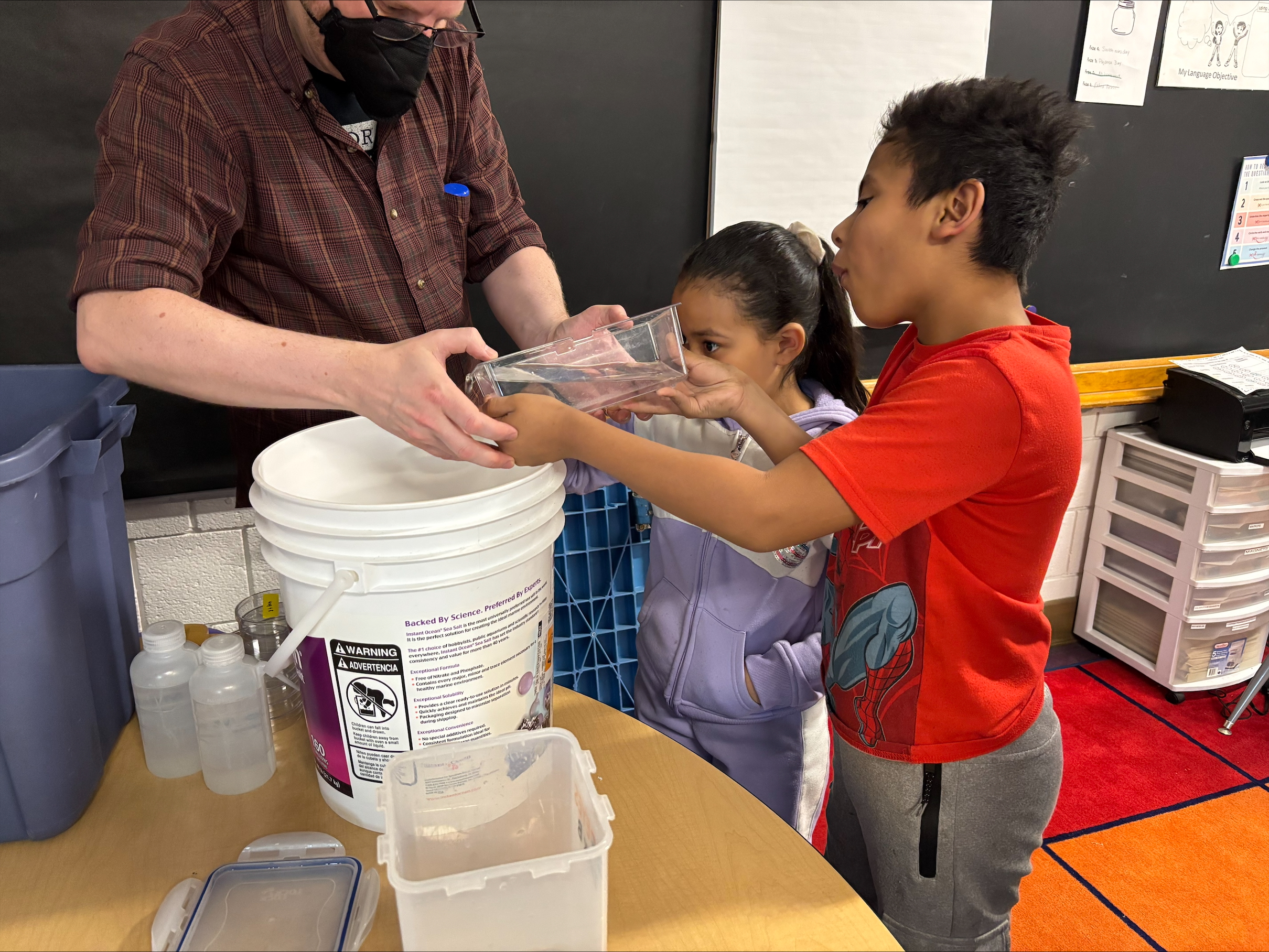
Students explored how the zebra fish's similarities to humans help scientists make progress on medical research. Students were able to make observations of real life fish that were brought into the classroom by a BIOEYES educator.
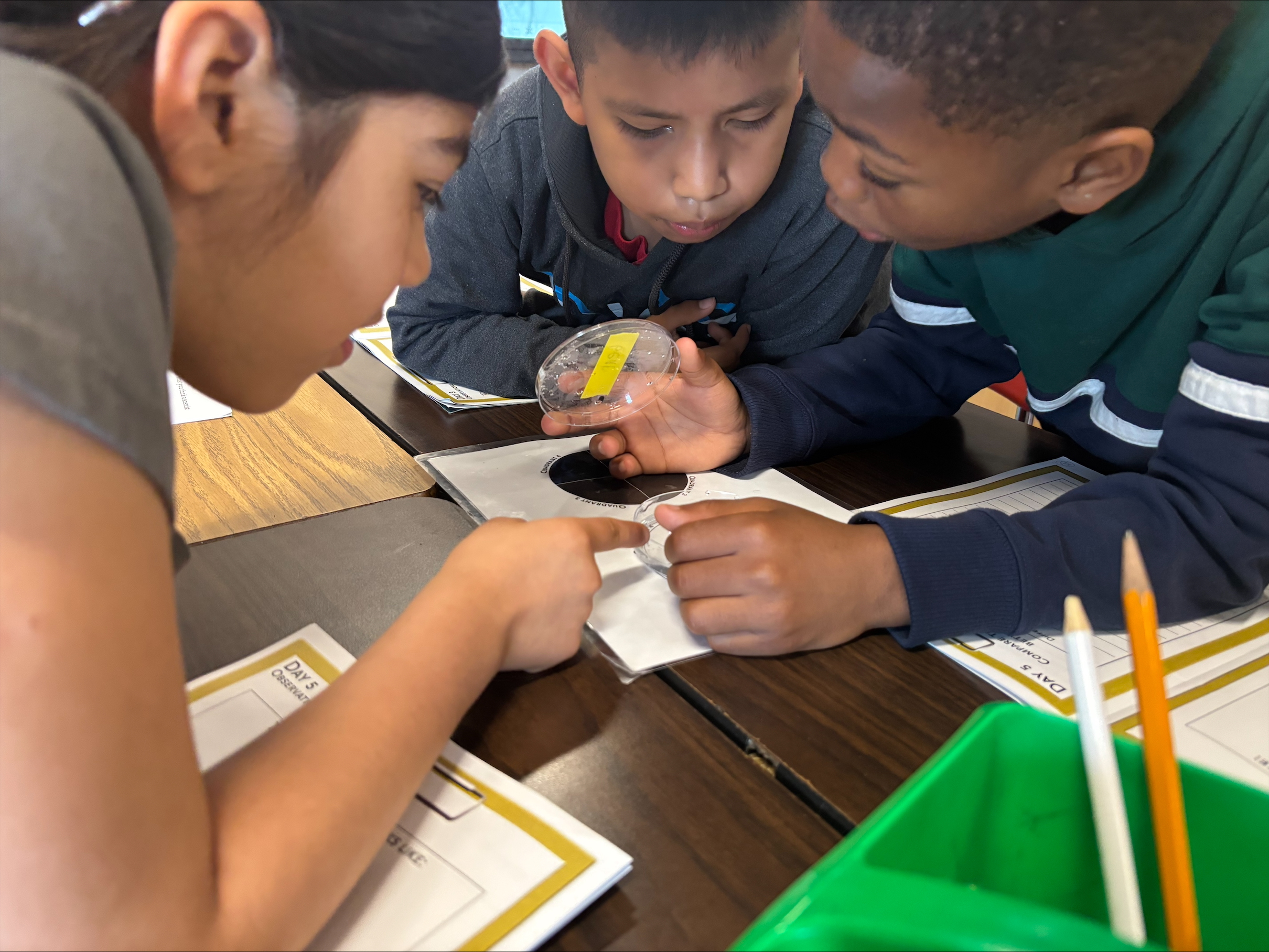
Students working together to analyze data from their experiments with the zebra fish.
Students working hands on with the BIOEYES teacher to choose the fish for their observations.
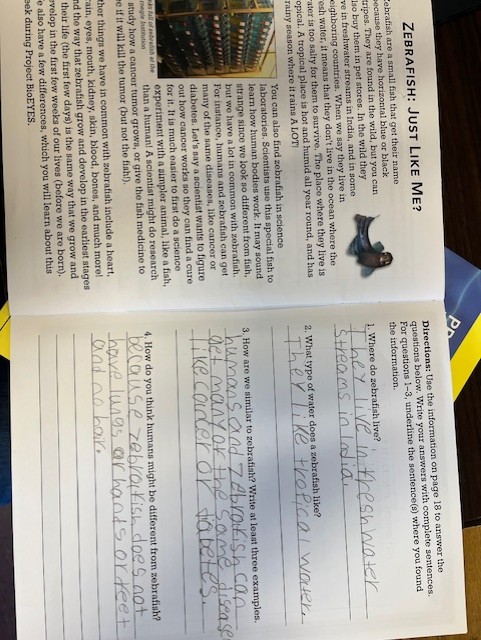
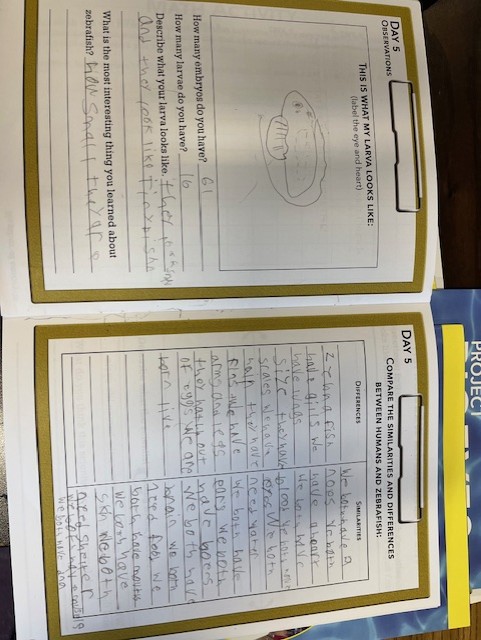
This is an example of the work book which was completed along with the BIOEYES program. This page is a reading which students also completed comprehension questions.
This page asked students to make observations and draw them, and then take notes about their findings.
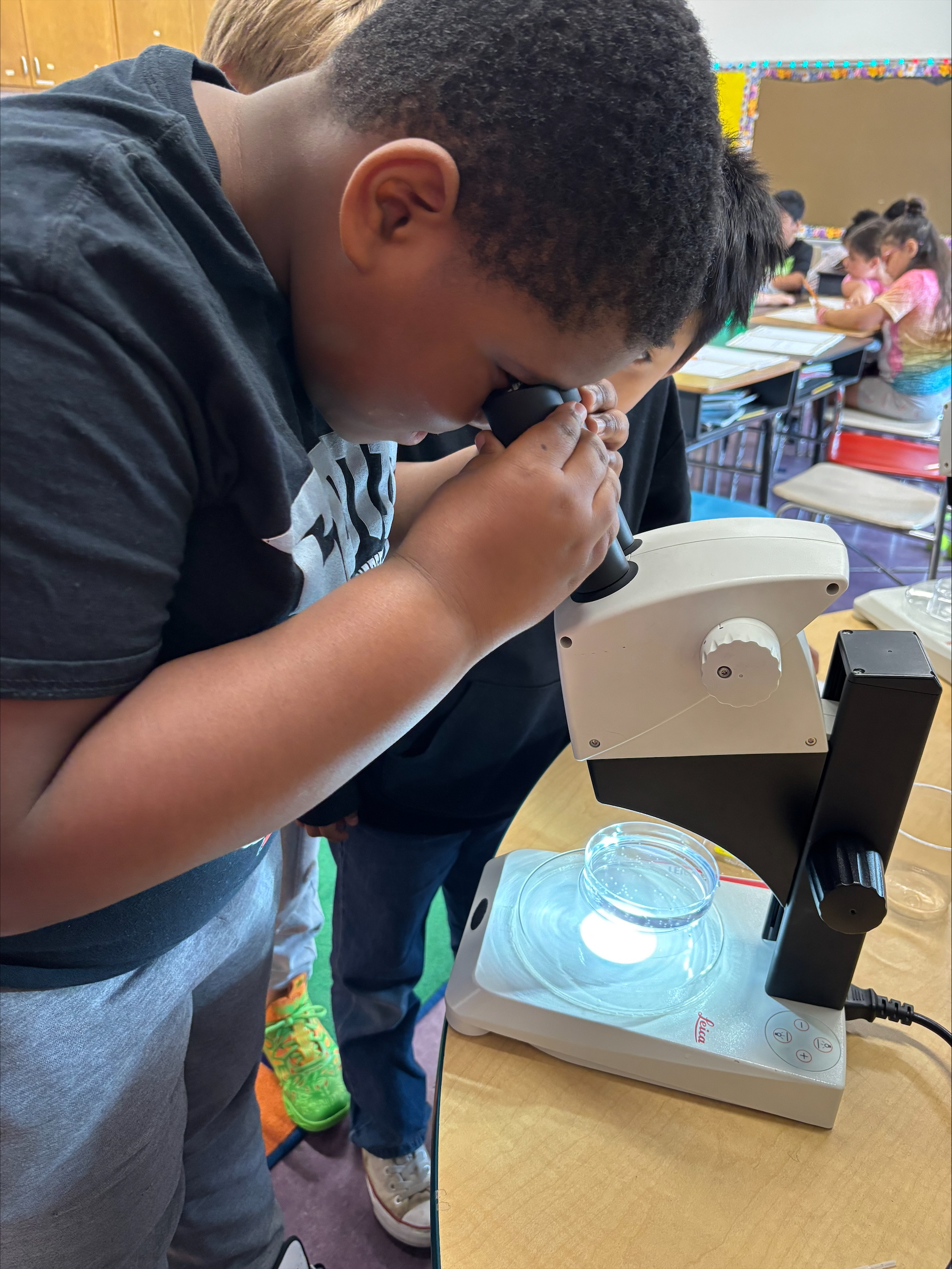
Students were able to get hands on experience of using microscopes to observe the fish eggs.
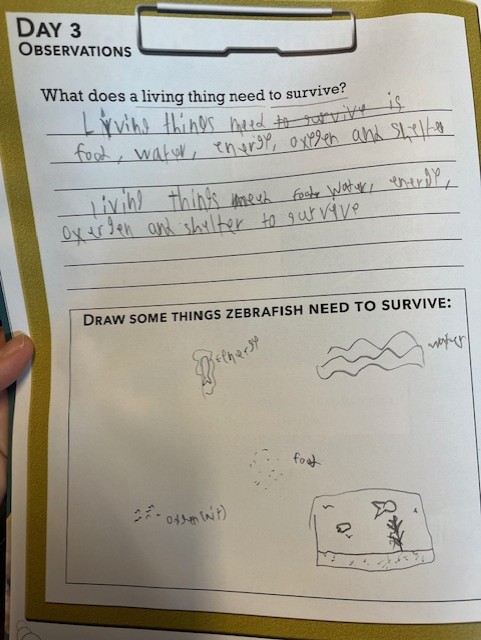
Further observations made by the students. This program occurred over the course of 5 days.
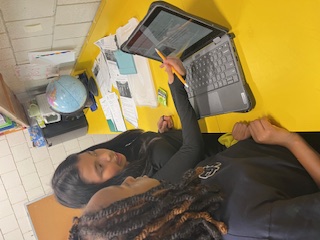
Students in the 5th grade science class were learning about conserving natural resources, which is unit 6 of the curriculum. In collaboration with the technology teacher, students prepared a google slide show of what they learned about environmental conservation. Students complied data from multiple sources to embed graphs and images to their slideshows. Lastly, the slideshows were shared with family members and lower grade levels.
5th grade student sharing her conservation of natural resources slide show with 3rd grader
Genesis Warren - Human Environmental Notes (1.72 MB)
Student presentation about conservation.
Alyssa Shrout - Human Environmental Notes (2.4 MB)
2nd Student example of 5th grade conservation project
Julio Ramirez Badillo - Human Environmental Notes (1.2 MB)
3rd student example of conservation project
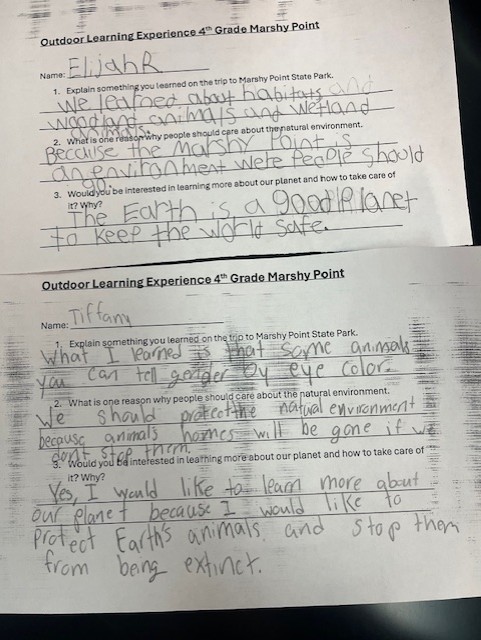
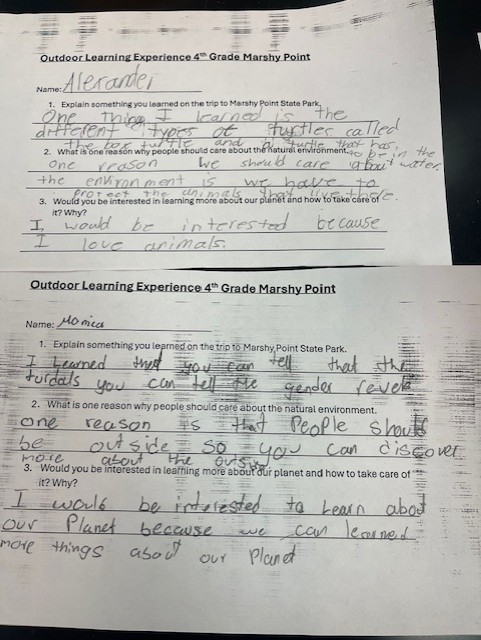
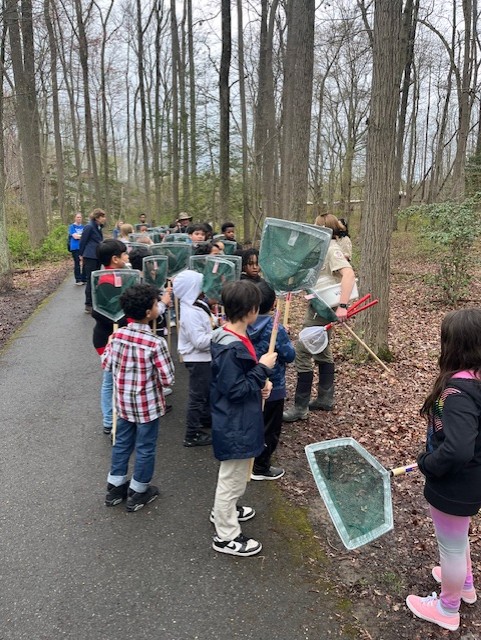
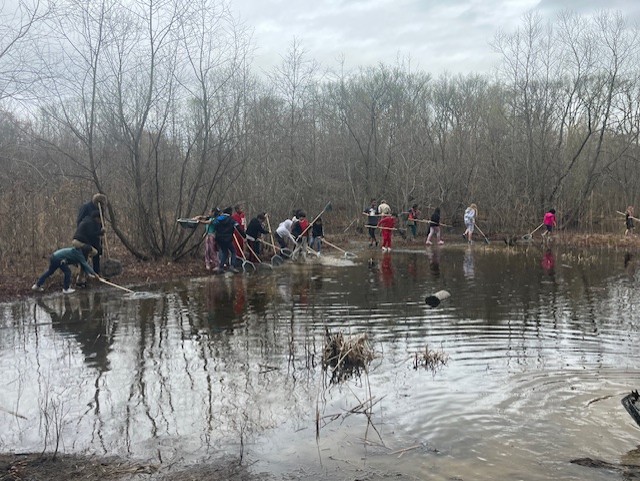
Homeroom teachers collaborated with the science teacher to provide students with an authentic fieldtrip. The students worked with a state park ranger and naturalist to learn about the native environment to support their understanding of the food chain which they were learning about in science class. Students composed reflections of their experiences. They also applied the knowledge they gained to the next science unit about food chains.
Students’ reflections about their trip to Marshy Point State Park #1
Students reflections about their trip to Marshy Point State Park #2
Students walking with materials through the paths in the park, listening to and working with the park ranger
Students 'skimming' the pond to find signs of life and the food chain.
Park ranger and naturalist providing a bi-lingual presentation about food chains in Marshy Point State Park
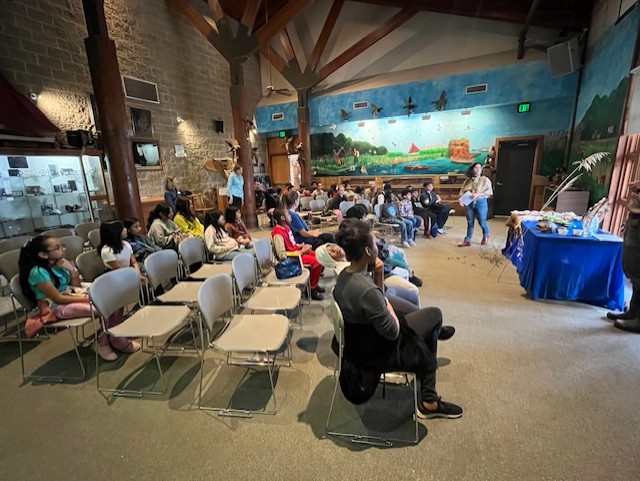
This field trip has become a tradition for our 1st grade students each year. We visit Great Kids Farm which is run by Baltimore City Public Schools' Food & Nutrition Services department. Students learn about nature and our environment and get benefits from learning outdoors. Immersion in nature provides a rich sensory experience that stimulates curiosity, creativity, and exploration. Physical activity associated with outdoor learning also promotes health and well-being, while the dynamic outdoor environment encourages collaboration, teamwork, and problem-solving skills. Students got to "taste the rainbow,' work in the garden and meet farm animals.
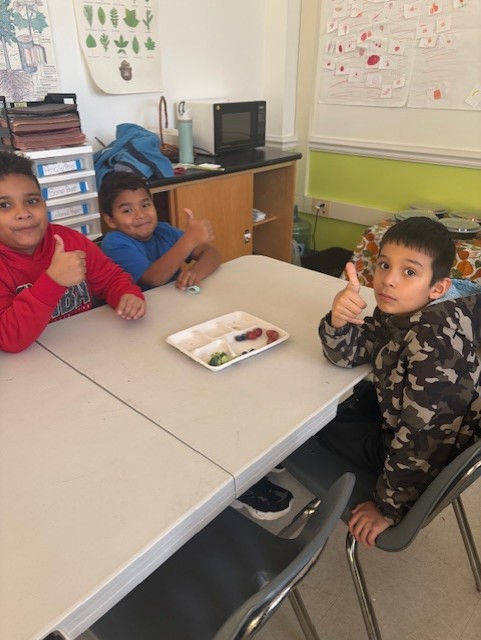
Students enjoying the foods they have freshly prepared
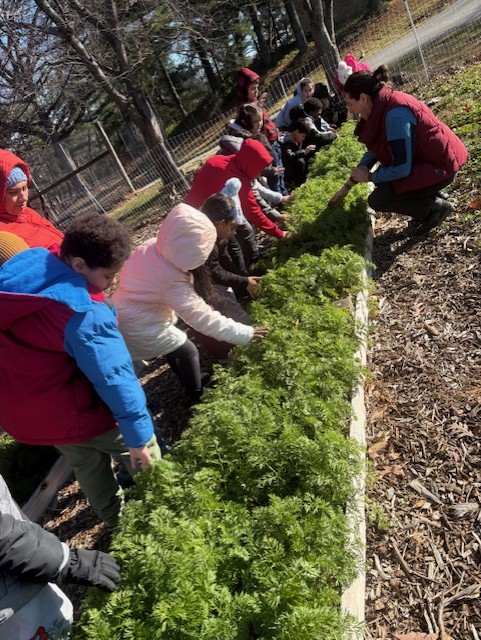
Hands on while students experience where our food comes from.
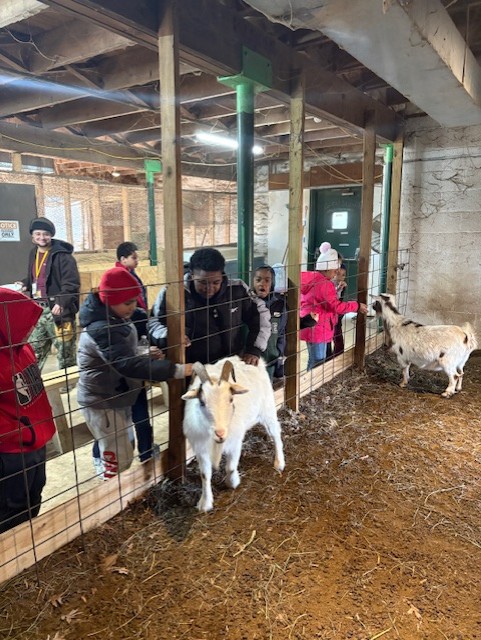
Students enjoying the opportunity to meet the farms goats.
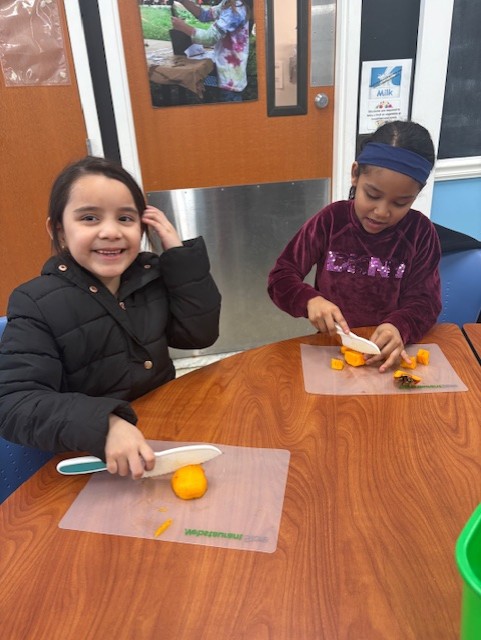
Students participated in the 'taste the rainbow' program and learned how to properly prepare foods.
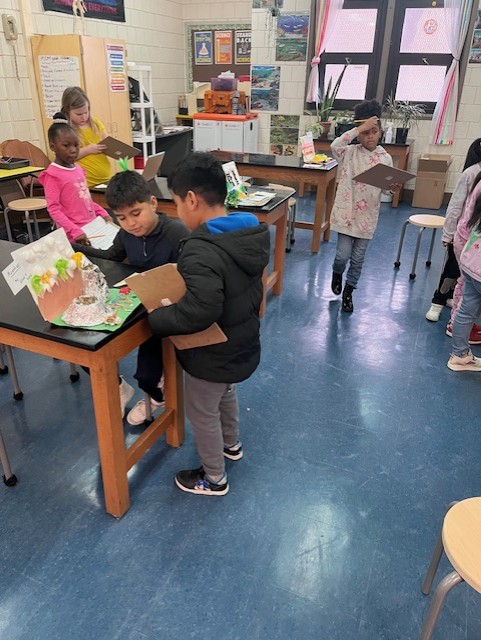
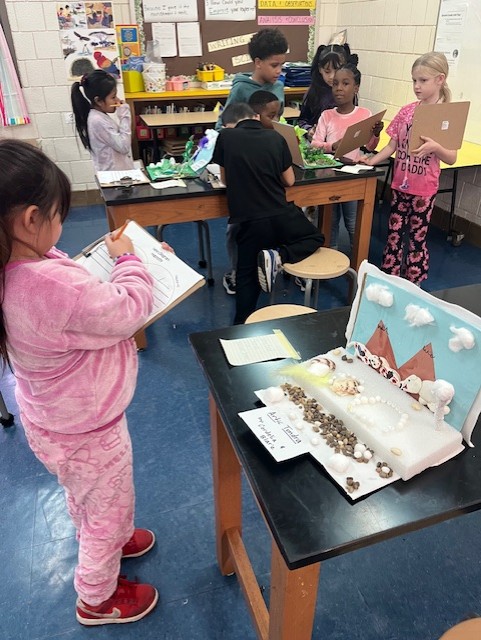
Students studied different natural habitats and why it is important to conserve and protect animals' natural habitats. They used recyclable materials to create and build habitat dioramas. After the completion of this project students did a gallery walk to compare and contrast each others habitats. We then displayed their dioramas for the school to observe.
This is student work completed post building of the dioramas. Students needed to compare and contrast two habitats that were not their own.
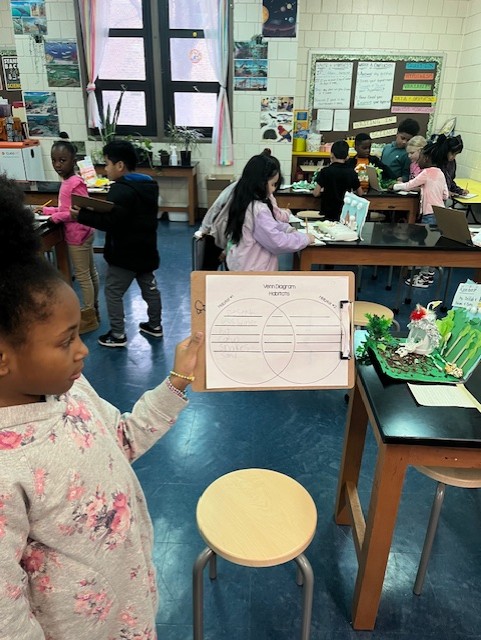
Students evaluating each others natural habitats based on the environment they represent
Additional student work
Students attended a field trip to the harbor and learn about the amazing work being done by the Waterfront Partnership. This tour was very in-depth. The students learned about Mr. Trash Wheel, oysters' impact on the environment, the new wetlands at the Aquarium, and how to sort our waste. This filed trip aligned with our curriculum about the Bay and our future MWEE projects.
Students played a game to learn how we should dispose of waste

We were able to tour the new wetland habitat outside of the aquarium and participate in activities.

Students starting off the ecotour with our bi-lingual host.

Oyster presentation

Surface run off experience

5. EcoTour Flyer (4.01 MB)
This flyer details the program and what we did.
5. Email Confirmation of Trip (371.57 KB)
This email confirms our trip with the program
The science curriculum has a unit asking the question, 'What do plants need?' Students investigated seeds by planting their own and caring for the class's mini green house. They also investigated plants that were not planted in soil, identifying that all plants do not require 'dirt.' The students were very proud of the seeds when they started to sprout!
Students sharing their findings.

Kindergarten comparing plants and discussing observations.

Student work, creating a table comparing two plants and their needs. Here we are putting an end to the misconception that plants require soil.

Student comparing plants with soil and without.

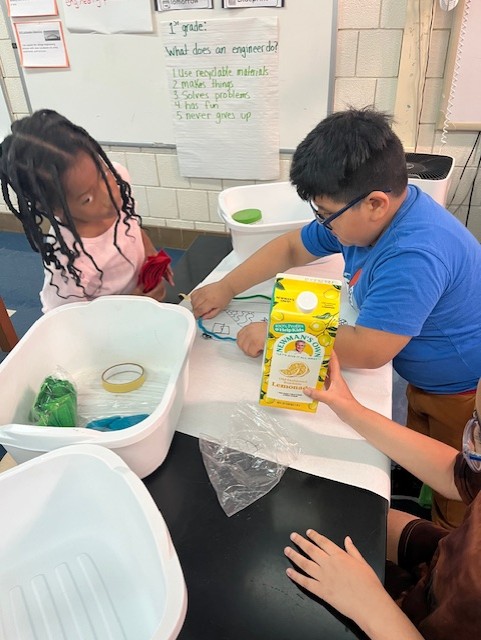
Second graders used the Design Engineering Process to build bird feeders using recyclable materials. Students observed that we do not often have birds in our school playground area but they are at the park across the street. This set the stage for the need of building bird feeders. They had to use 'CCB Bucks' to 'purchase' the materials. They only had $20 to spend to build their bird houses. Students were very proud of their hard work.
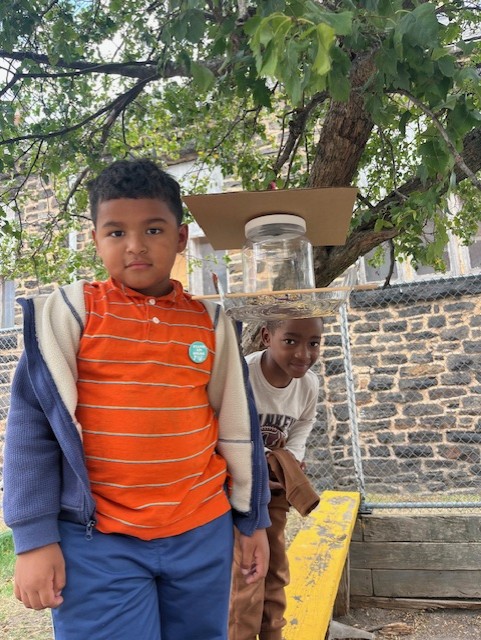
Students after hanging up our bird feeders on school grounds
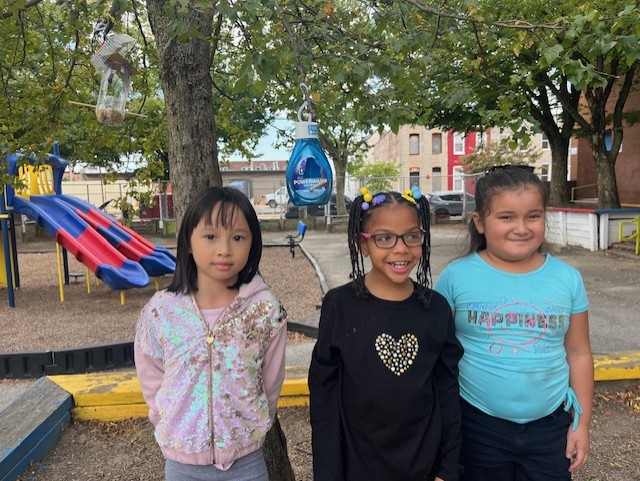
Another group's final product
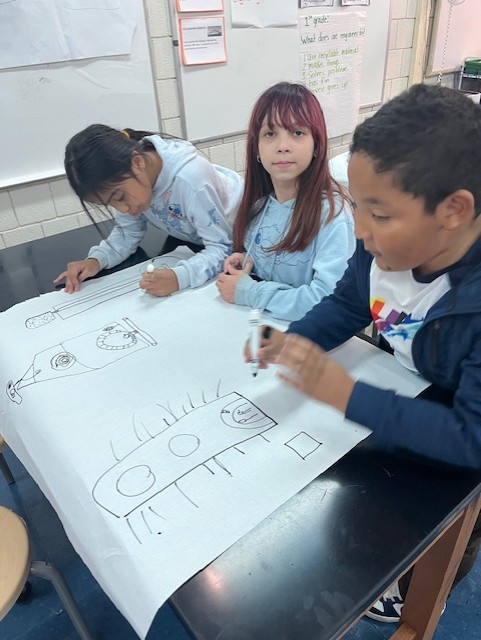
Students in stage two of the design process. Working together to brainstorm and develop ideas for their group bird house.
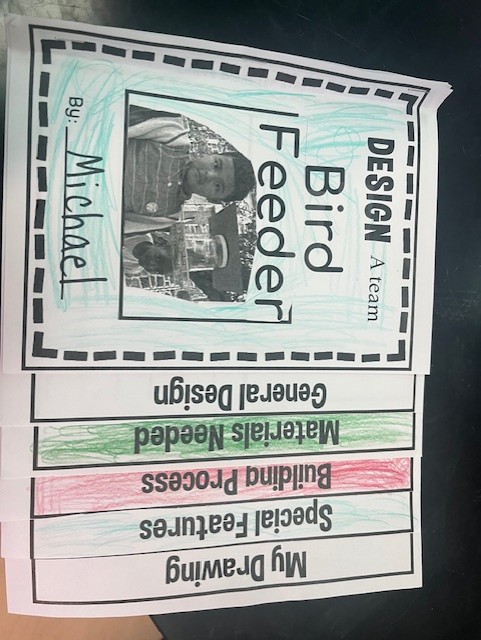
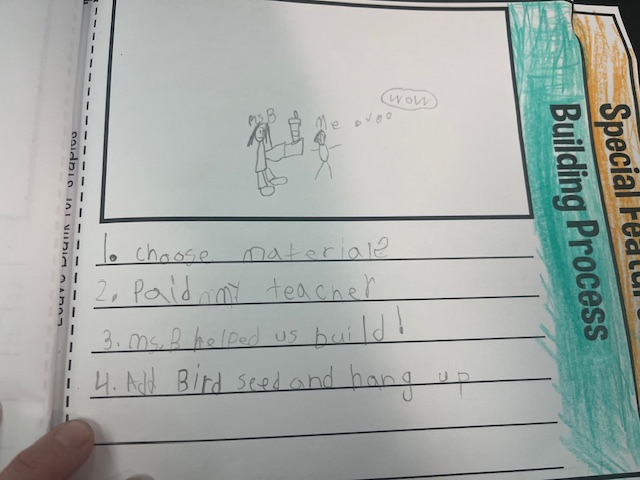
This is the journal students used to document our steps through the design process. Students were able to reflect and process our steps to solve the problem.
Here students have completed a preliminary design and have moved on to using the materials to make choices for what to use from our recyclables. They must also use 'CCB Bucks' to 'purchase' the materials. They only had $20 to spend to build their bird houses.
Example of a student's entry in our design journals. This shows our process to build the feeders.
1.2 Green School Awareness
1.2.1 Schoolwide Awareness - Staff
Demonstrate that all school personnel are aware of your school's Green School status and application process.
Acceptable Documentation: Staff meeting agenda or staff sign-in sheet with date and clear description of an all-staff presentation about your Green School efforts; this can be a showing of the MAEOE presentation video on "What it Means to be a Maryland Green School" found on the portal.
The staff of our school are very eager to be more active with the Green School process. Below is documentation that helped make sure our entire staff was aware of the Maryland Green School application process.
This is documentation for our first whole-school staff meeting of the 2024-25.
There is also documentation from this year 2025-26 as we have continued to strive to become a green school
Staff Engagment Meeting Agenda 09-03-24 (82.48 KB)
Staff meeting agenda for the beginning of the 2024-25 school year where Ms. Bainbridge presented about the Green School Application process to the full whole staff.
sign in sheet 9.4.24 (171.17 KB)
Completed sign in sheet from above stated staff meeting 2024-25
This is documentation for another staff meeting in 2025-26. This is the second year we have made sure to include the whole staff in a conversation about our green school application. This artifact has our notes from the meeting, staff sign in sheet, and the agenda.
Staff Engagement Sign-In 10-06-25 (173.54 KB)
Staff sign in sheet
Staff Engagment Meeting Agenda 10-06-25 (49.78 KB)
Agenda
Whole Staff Notes (16.04 KB)
Agenda with notes and next steps with staff and green team
1.2.2 Schoolwide Celebration
Demonstrate how your school celebrates being a Green School by hosting a schoolwide environmentally-focused event open to all students.
Acceptable Documentation: Photos of students in all grades participating in activities celebrating Earth Day or other environment-themed holidays such as Earth Hour, America Recycles Day, World Water Day, Arbor Day, etc. and/or detailed event agendas or newsletters describing these celebrations.
There are four events documented below:
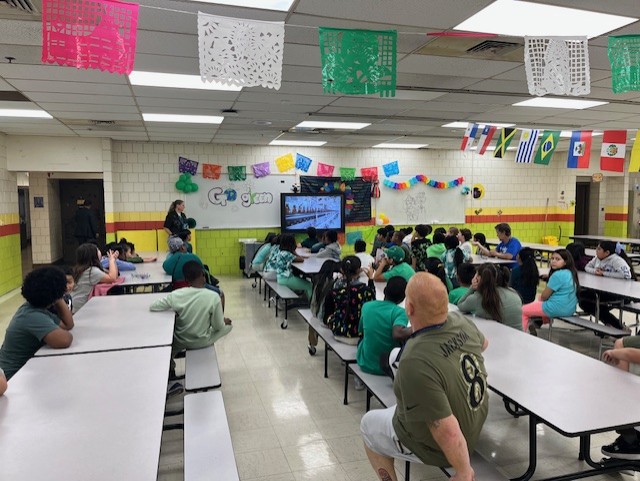
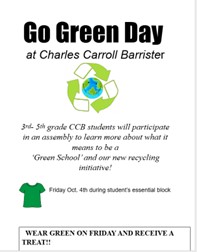
Event 1 is a 'Go Green Day' assembly with all grade levels to raise awareness of our school's new and improved mission for sustainability.
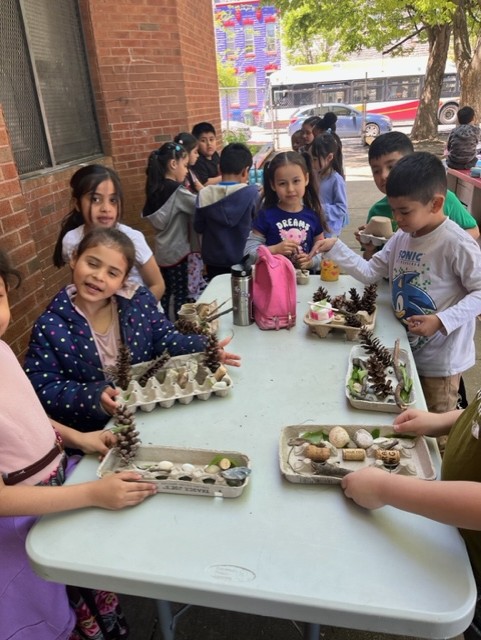
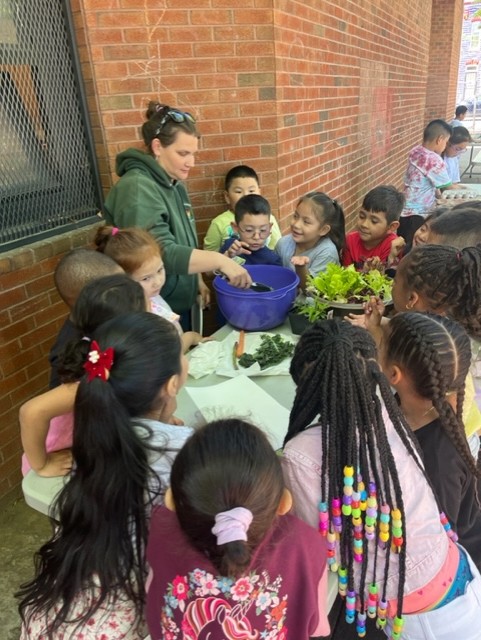
Event 2 is our school wide Earth Day event that was held in collaboration with Taste Wise Kids.
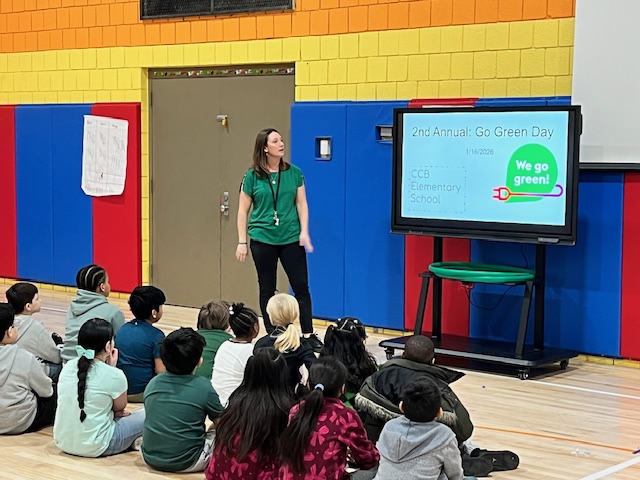
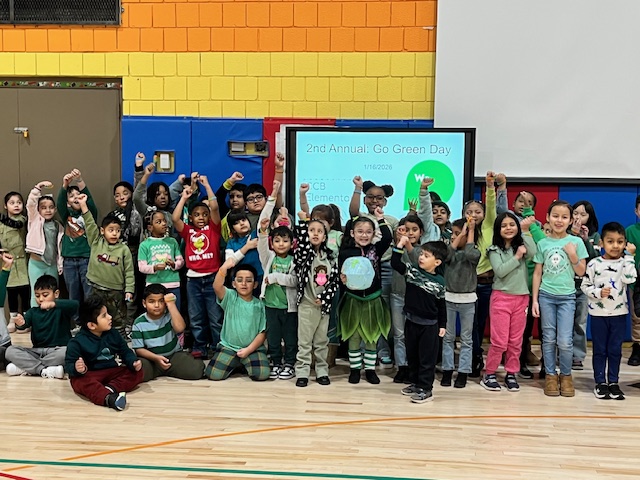
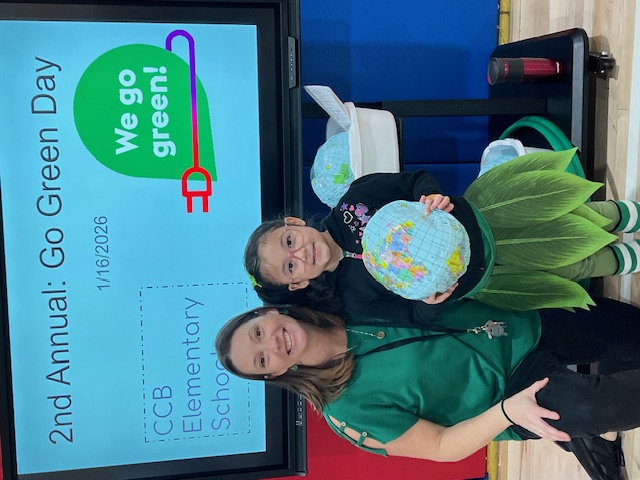
Event 3 is the second annual "Go Green Day."
Event 4 is our upcoming Earth Day event.
The goal of this event was to hold an assembly for all students and staff to introduce them to 'being green.' Students of all grade level learned what sustainability means and how we can 'Go Green' as a school community. Staff and students discussed our new recycling initiative and what their roles are in the process of collecting recyclable materials from the classroom. To make it fun and engaging we asked all staff and students to wear green on this day!
To help students learn more about the natural world outside of Baltimore we have watched documentaries about plastics in our ecosystem and had reflective conversations.
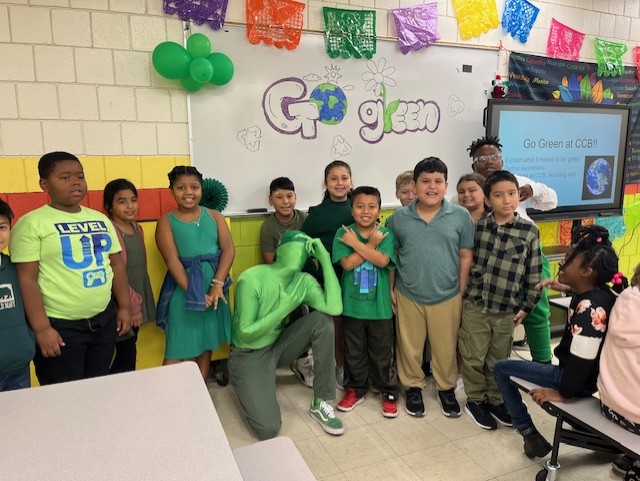
3rd grade posing with our Go Green Mascot!
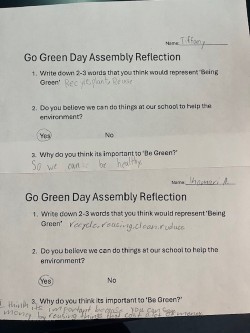
Student reflections about the Go Green Day
Students and staff viewing and participating in our Go Green programming
This is a picture of the flyer sent home before our first Go Green Day
On this day we collaborated with Taste Wise Kids (https://www.tastewisekids.org/) who are on-going partners in our school. Students of all grade levels participated in Earth Day themed stations including: planting, worm composting, upcycling art projects, and an Earth Day- School wide promise.
Students building bug hotels in one of the stations.
Students enjoying fresh greens and learning about the farm they came from.
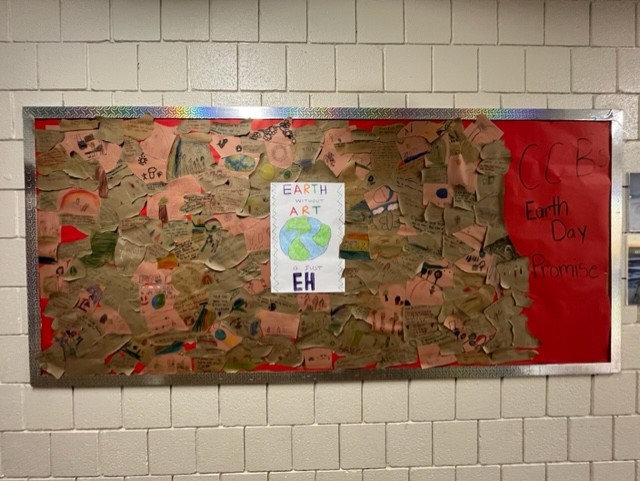
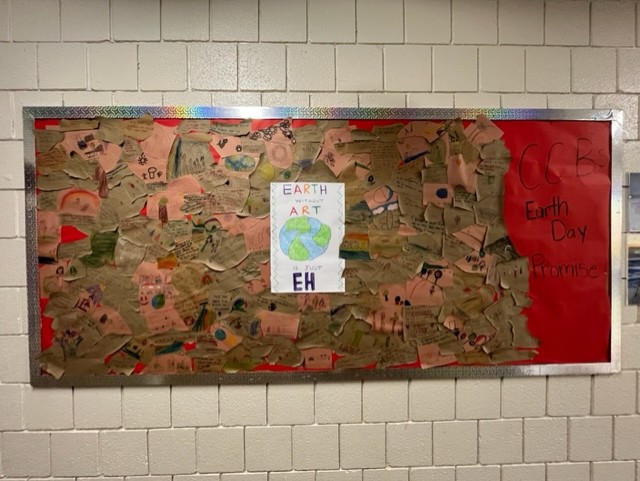
This is our whole school pledge. Each student documented something they learned or why they want to do the best for the environment. We made a school bulletin board with their pledge.
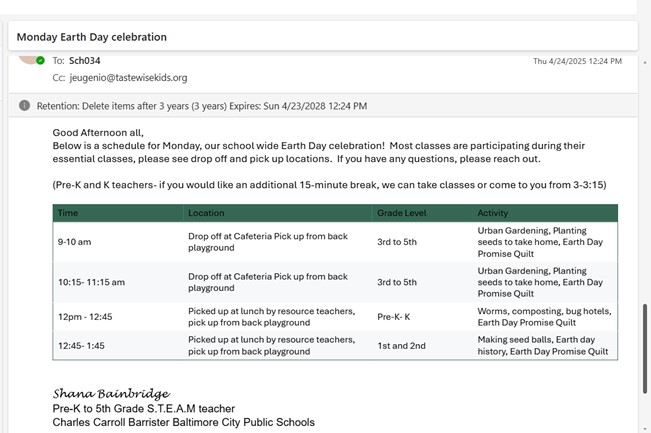
Whole school schedule for all students to participate in stations and whole class celebration
Earth Day Email collaboration (498.34 KB)
The attached PDF documents the collaboration with Taste Wise Kids in order to make this special day happen!
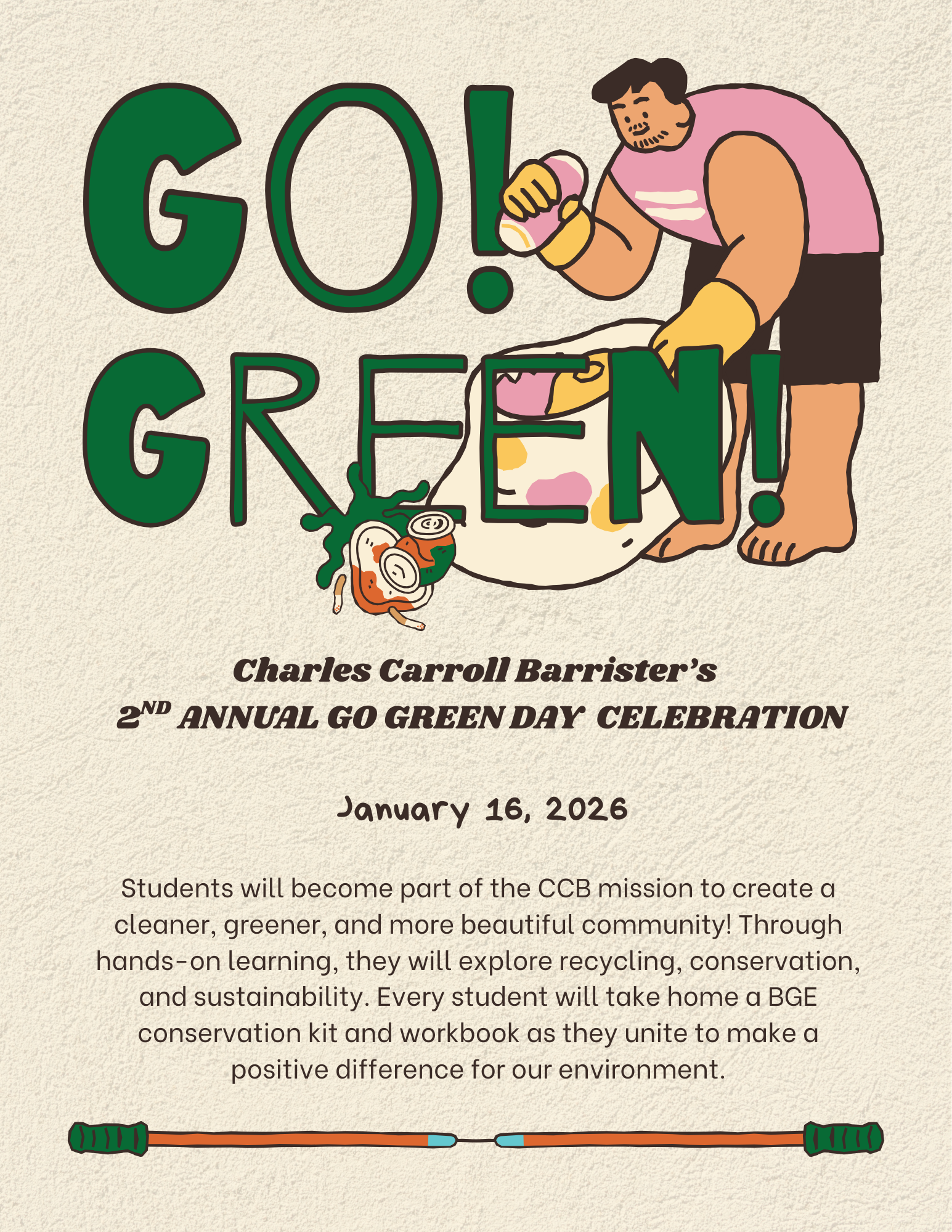
Students will participate in activities geared towards our Green School initiatives. For our second annual Go Green day- students and teachers were made aware once again of our school effort to become a green school. Students learned about conserving natural resources and learned tips about how to save energy at home and school. Through a partnership with BGE students received boxes to take home that have several items that can be used at home to use energy and resources wisely.
Flyer for the 2nd annual Go Green Day in 2026.
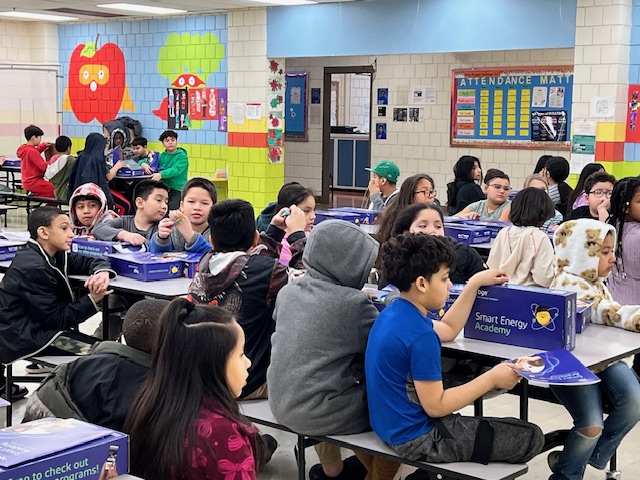
Upper elementary moved in the cafeteria to receive their kits and review what was included for their families. Items included; a new water head for shower, sink, and bathroom facet. Also a new power strip that is more energy efficient.
Upper elementary posing in their Go Green attire.
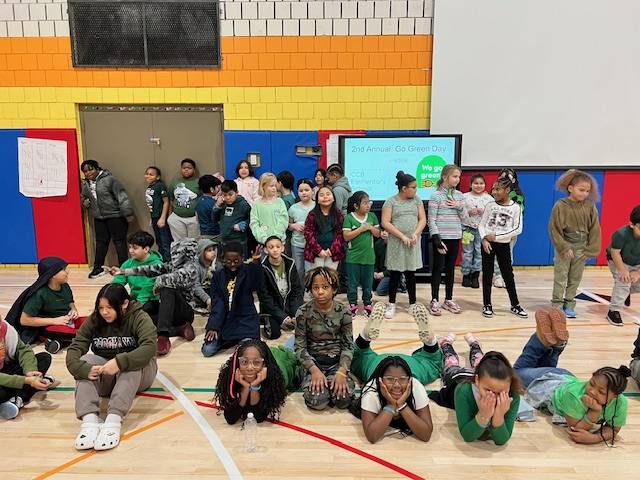
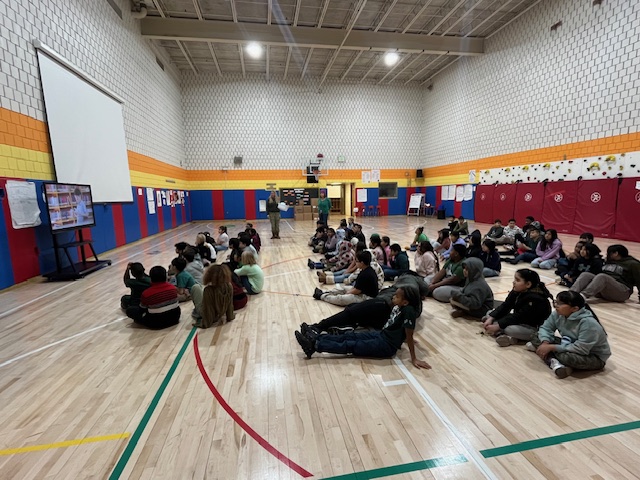
Part of Go Green Day was having a discussion about sustainability and the importance of conserving energy
Lower elementary students celebrating Go Green Day
This picture was just adorable so it is included, it is an example of students supporting and dressing up for Go Green Day!
The assembly was broken up in to two groups this shows the upper elementary students
email 2nd annual Go Green Day (167.55 KB)
In this email document myself (the science teacher) and the Community Coordinator worked together to prepare and implement the second annual Go Green Day!
BGE partnership email and family material boxes (273.49 KB)
This email shows evidence of receiving and working in partnership with BGE outreach program.
While this day has not occurred, we are able to show documentation of the upcoming event that is planned to occur. We will once again be working with Taste Wise Kids to help support us in implementing a school wide annual activity.
Earth Day 2026 Confirmation (599.12 KB)
This email confirms our 2nd annual Earth Day celebration for this April- perhaps a celebration of achieving Green School Status as well! ** See information circled in red
2026 Earth Day Celebration Monday Message to Staff (241.87 KB)
Please see the second page of this document which shows confirmation of Earth Day, Spring 2026. The Monday message is our principals means of weekly staff communication; he requests that staff mark their calendars in anticipation of our Earth Day Celebration this spring.
1.3 Environmental Professional Development for Teachers
1.3 Environmental Professional Development for Teachers
Demonstrate that 10% of instructional staff have completed an environmental PD. Instructional staff is defined as any staff that manages a gradebook.
- New Schools must have all PD completed within the past 2 years.
- Renewing schools must have all PD completed within the past 4 years.
A teacher who has participated in multiple workshops may only be counted once.
Acceptable Documentation: A certificate of completion from any MAEOE training or recommended PD listed on www.MAEOE.org under Professional Learning or any environmental training provided by your school district.
Six classroom teachers dedicated a Saturday in the fall of 2025 to attending a professional development at our school. We collaborated with ANBE, The Association of Nature-Based Education (https://naturebasededucation.org/). Attached are the certificates of completion for all six staff members. This is a MSDE registered credit hour course. In addition to the PD, we have implemented some of what we learned into our classrooms and green club. The art teachers used nature based objects for still life drawing, ELA teachers brought their students outside for independent reading and activities, and our green club created learning games for the kindergarten and pre-k.
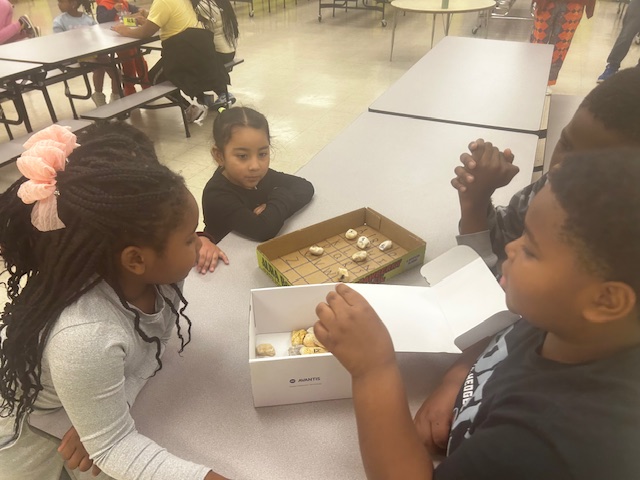
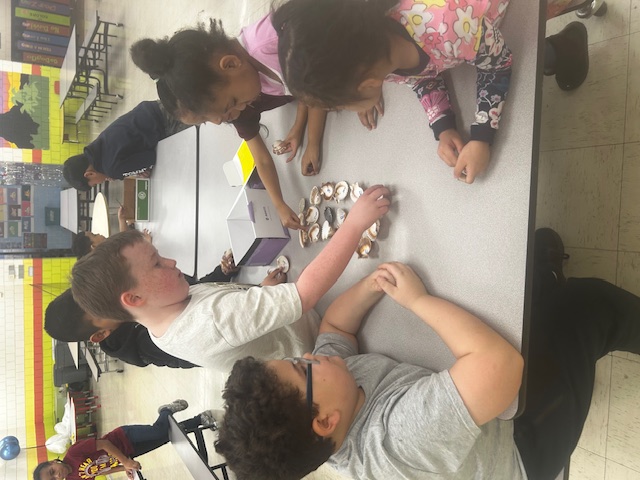
We collaborated with ANBE, The Association of Nature-Based Education. We focused on bringing nature into our curriculum. She used information learned from the PD to work with the green club (4th and 5th graders) to create nature based games and activities to learn from. Some example include, counting with shells, making words with rocks that have letters on them, and matching leaf puzzles!
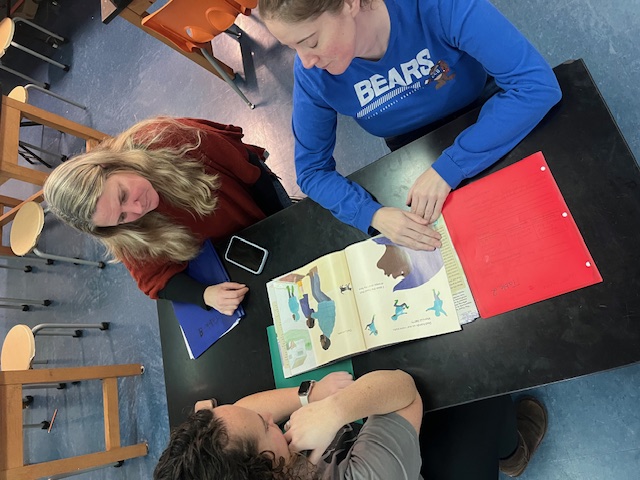
Staff participating in PD
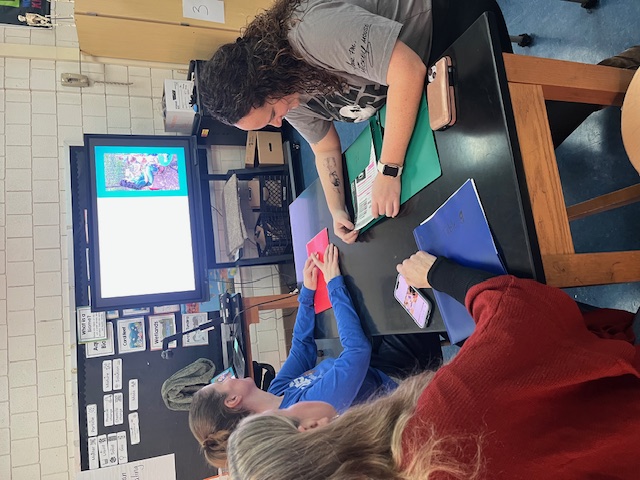
One focus of the PD was using literacy about the environment or nature to support the classroom and learners
Shana Bainbridge_NBL Indoors and Out Certificate 10.25.25 (643.42 KB)
Shana Bainbridge professional development certificate of completion
Green PD 1 (205.97 KB)
E-mail promoting the opportunity for the PD that was held with ANBE
We collaborated with ANBE, The Association of Nature-Based Education. We focused on bringing nature into our curriculum. She used information learned from the PD to work with the green club (4th and 5th graders) to create nature based games and activities to learn from. Some example include, counting with shells, making words with rocks that have letters on them, and matching leaf puzzles!
Camille Greaney_NBL Indoors and Out Certificate 10.25.25 (640.74 KB)
Camille Greaney certificate of completion
We collaborated with ANBE, The Association of Nature-Based Education. We focused on bringing nature into our curriculum.
Erica Voss_NBL Indoors and Out Certificate 10.25.25 (636.65 KB)
certificate of completion
We collaborated with ANBE, The Association of Nature-Based Education. We focused on bringing nature into our curriculum.
Luis Sierra_NBL Indoors and Out Certificate 10.25.25 (639.38 KB)
Certificate of completion
We collaborated with ANBE, The Association of Nature-Based Education. We focused on bringing nature into our curriculum.
Eleanor Hade_NBL Indoors and Out Certificate 10.25.25 (638.82 KB)
certificate of completion
We collaborated with ANBE, The Association of Nature-Based Education. We focused on bringing nature into our curriculum. As the art teacher she has been able to use nature in her instruction more often
Mary Ford_NBL Indoors and Out Certificate 10.25.25 (638.75 KB)
certificate of completion
1.4 Sustainable School Practices
1.4.1 Schoolwide Staff Sustainability
Demonstrate the sustainability practices your teachers, staff, and other personnel have implemented school-wide to make your school green. Any actions involving students belong under Objective 2.
Acceptable Documentation: Photos of practices being implemented by staff and/or policy documents that describe sustainable behaviors such as reducing paper use via double-sided copying or electronic communications, de-lamping or using natural light or task lamps to conserve energy; incentivizing carpooling or public transportation; reducing waste in the staff lounge; etc. You may also include the installation of sustainability features at your school such as solar panels, geothermal heating, water bottle refilling stations, etc.
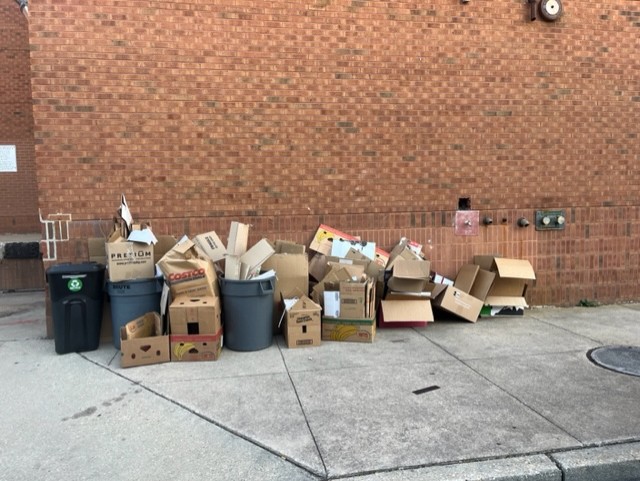
- Recycling: an adult action due to the surrounding neighborhood. It is unsafe for the students to take out the recycling and it can not be done the night before due to the theft of our cans(x3). Staff must closely monitor what goes into cans due to pest and potential for smell. The community volunteer who provides support for our food pantry takes the recycling out each Thursday morning at 6 am and monitors pick up so the cans can be taken in quickly.
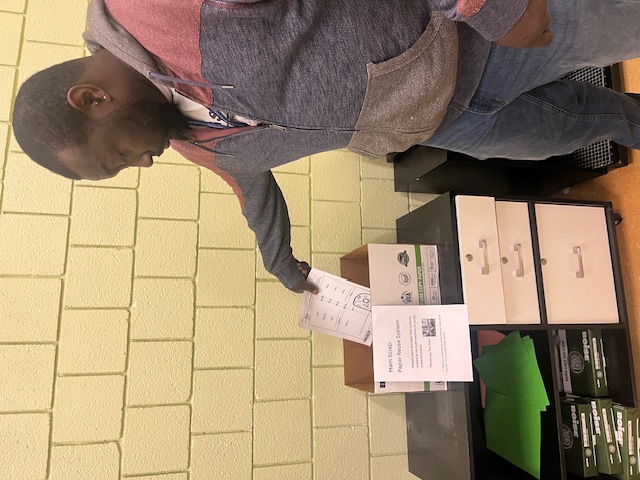
- Math Scrap Paper reuse system: Teachers will be placing discarded 'extras' in a bin so it can be used by our math classrooms as scratch paper. The art teacher started this program after seeing our success in staff led recycling.
Our location for recycling must be down the back side of our school across from an alley. Due to safety concerns in our community this cannot be a student job.
Staff member using the Math Scrap bin- the next step is for math teachers to use this paper in their classrooms as scrap paper.
recycling reminder (64.54 KB)
Recycling reminder to staff, since this is done by staff to ensure safety and that we meet the guidelines by the city
commuity struggles with recycling (159.13 KB)
This is a series of emails which documents the struggles we have with our surrounding school community and our loading dock area. We have needed to adjust the placement of our recycling several times- it has need essential for adult staff to collaborate in order to make this successful.
Inititation of recycling program confirmation (154.22 KB)
Initiation confirmation about starting recycling as CCB again for the first time in many years
Recycling concerns 1 (270.59 KB)
Again for the second year we have issues with our trash cans being stolen and then were told that we can not use recycled paper bags. As the adults we needed to adjust to be able to continue to recycle at the school.
Recycling concerns 2 (128.52 KB)
Communication with staff about the recycling concerns and how the adults need to adjust.
MATH SCRAP (171.38 KB)
Flyer presented to staff about our new Math Scratch paper program
Paper Saving email to staff (115.59 KB)
This email outlines the plan for reusing paper in the copy room for scrap paper in math. A math teacher's reply shows the need for this type of action.
1.4.2 Systemic Partnership
Demonstrate at least one partnership with a central office or board within the school system that supports part of the Maryland Green Schools Program. Any partnerships outside of your school system belong under Objective 3. Independent schools may partner with their board of trustees, parish office/archdiocese, or funders.
Acceptable Documentation: Sustainability plans, letters from district partners, or completed program applications as well as photos of practices being implemented in partnership with your systemic partner.
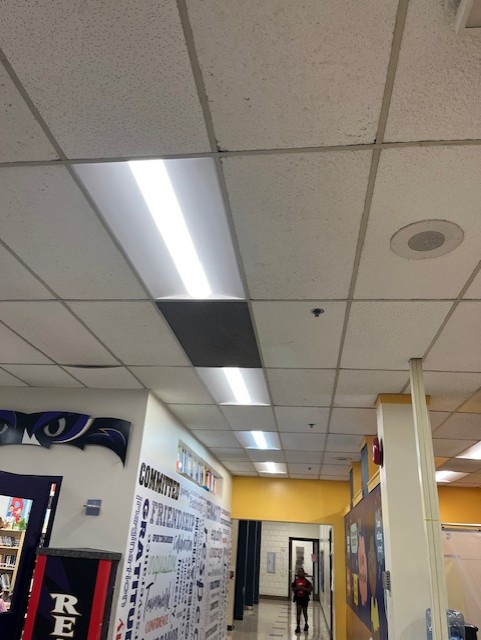
City Schools and CCB partnered to install new, more energy efficient lighting in our school during the 2024-25 school year. Working at night as to not disturb learning, the department of Energy Efficiency and Operations installed new lighting in our entire school.
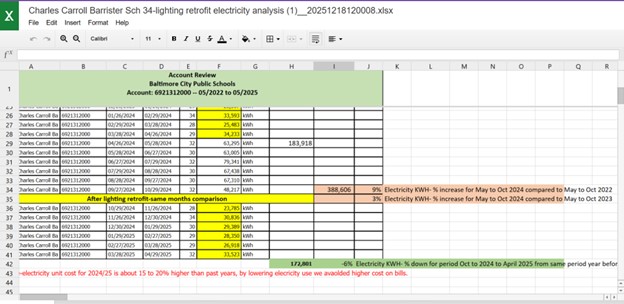
This is a screen shot of the same data presented in the record of an excel sheet.
New lighting that is much softer and energy efficient.
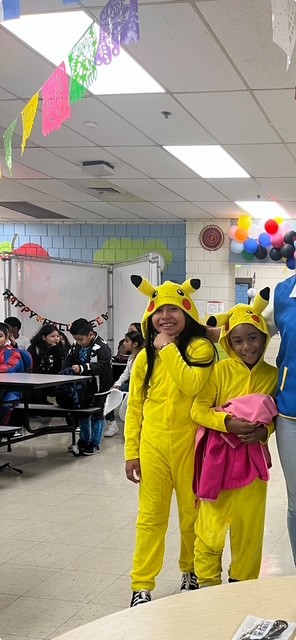
Before picture of lighting (see above adorable Pikachu's)
conservation due to lighting project email (249.46 KB)
This email outlines the continued collaboration with the district and the results of the updated lighting which was installed.
lighting email (177.39 KB)
This email outlines the continued collaboration with the district and the results of the updated lighting which was installed.
Charles Carroll Barrister Sch 34-lighting retrofit electricity analysis (1) (14.37 KB)
This is the data provided by the district about the energy saved each year with the new lighting that was implemented. It's important to note the KWH usage and not the cost- as energy costs have increased our usage has gone down.
Please note: you may need to scroll to the left to see the whole spread sheet
No records were added by the school.
Student Action
Schools must document eight total actions that address at least three of the listed sustainability practices.
These are student actions, not adult actions. Adult sustainable actions can be documented in Objective 1.4.
2.1 Water Conservation/Pollution Prevention
2.1 Water Conservation/Pollution Prevention
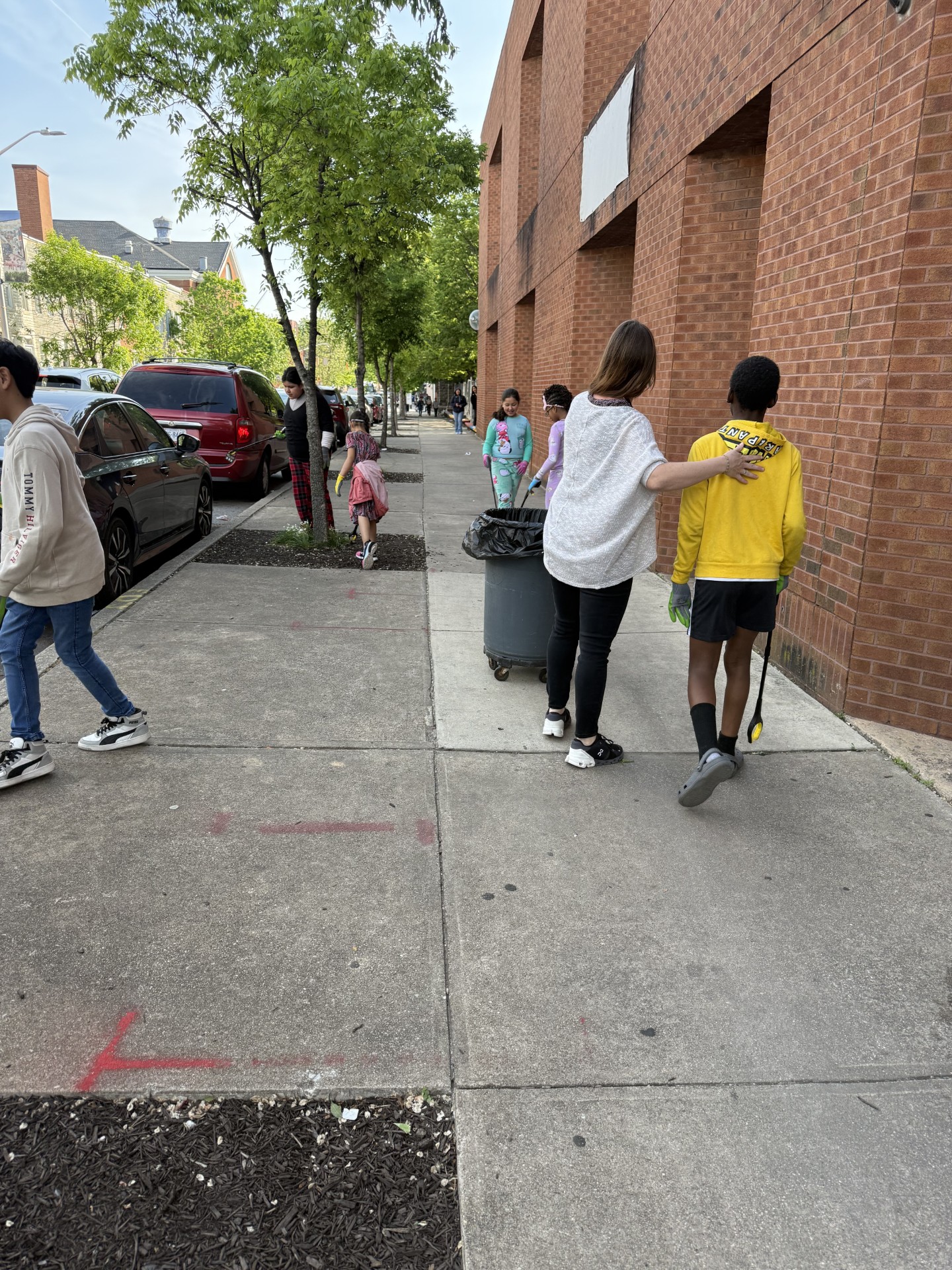
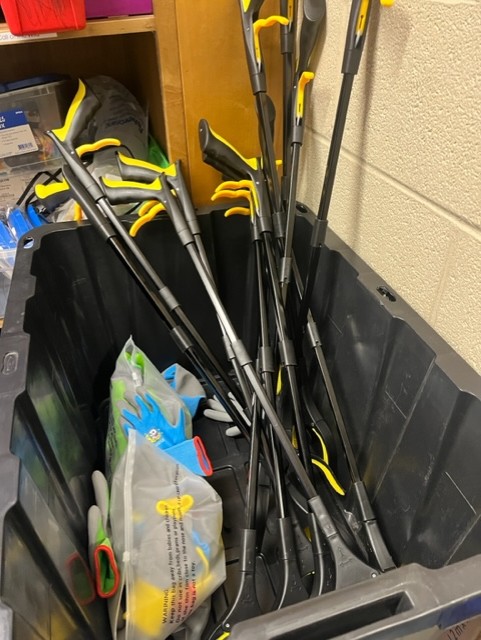
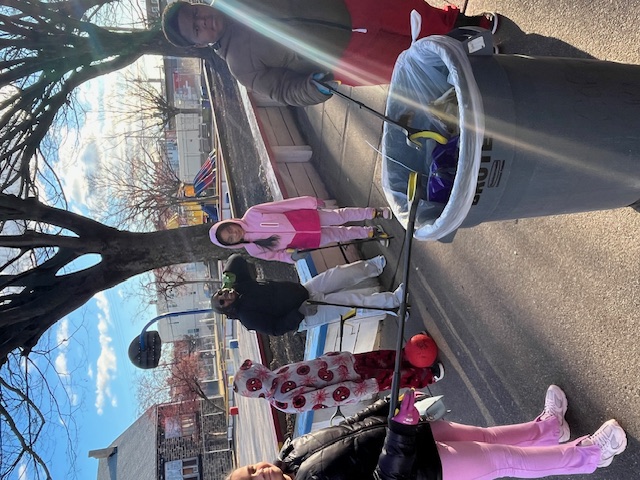
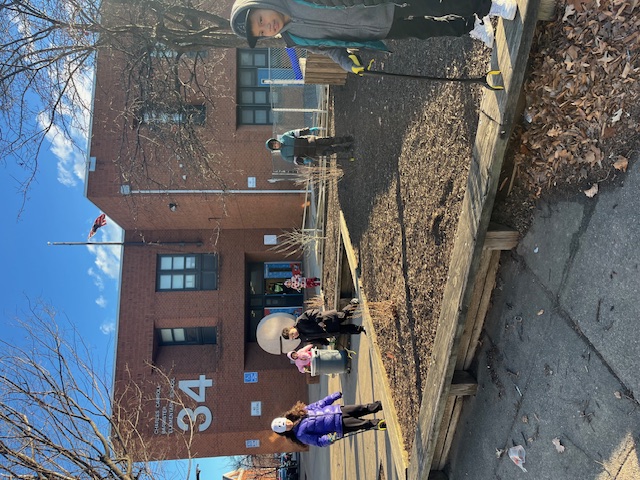
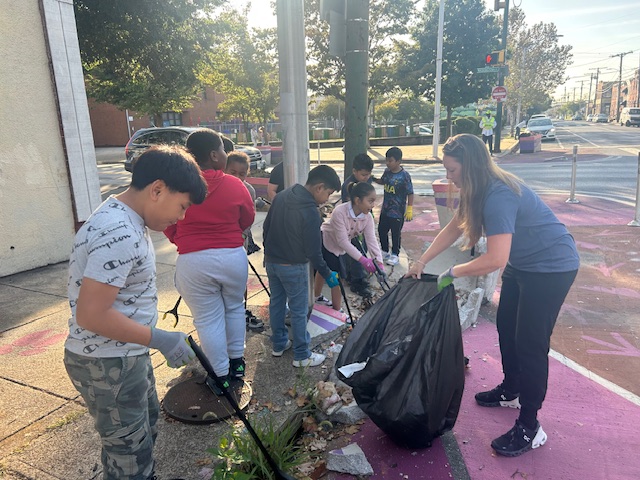
This sustainability project continues throughout the year. The Green Club chose to use some of their funds from the Green Healthy Smart Challenge (a program of the Baltimore City Office of Sustainability) to purchase trash grabbers and gloves. Our school is in an urban area and it is not safe to pick up trash with only gloves. Students must use the grabbers for each piece of trash. We do our best to recycle materials when possible. We do trash pick up every Thursday morning when the weather is agreeable. This student-led activity has grown in the second year- please see the connected record 2.
In this first year we stayed close to the school in our clean up efforts.
Our supplies to stay safe while cleaning up
Back playground trash pick up
School based trash pick up
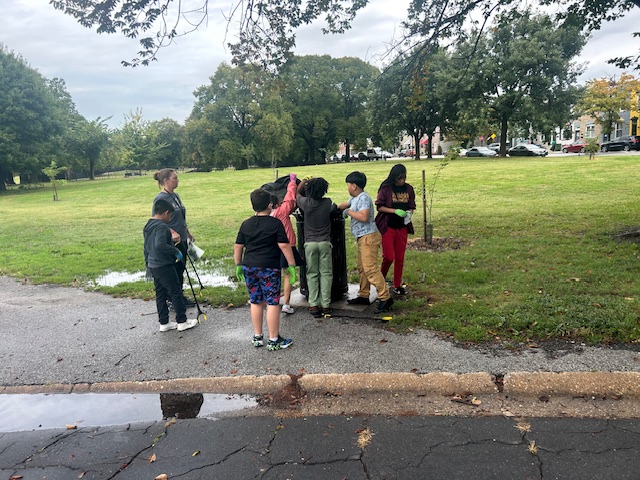
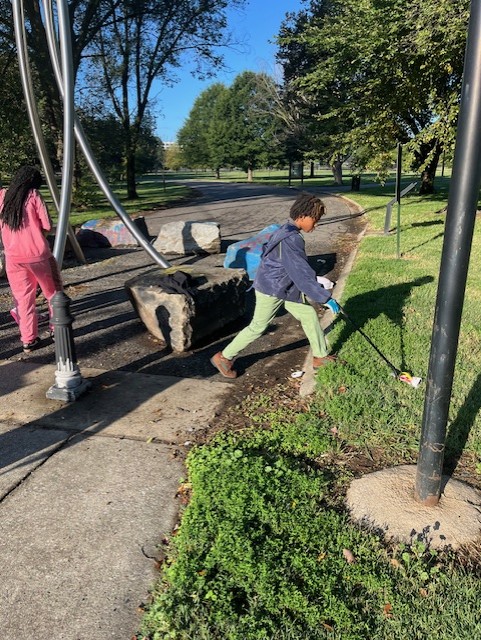
In the second year of trash clean up the students have expanded into the near by park and partnered with the Friends of Carroll Park, a nonprofit organization (https://www.friendsofcarrollpark.org/). This artifact will be referenced again in the 3rd section of the application. It was important to show how this small idea has grown larger and larger.
Leaving school grounds to expand our clean up
Working in the park each Thursday
The kids want to go out no matter the weather!
2.2 Energy Conservation
2.2 Energy Conservation
Our Green Club has been sharing 'Friday Facts' on the morning announcements since October 2024. The members of the club research their facts to share and practice throughout the week before speaking to the school. The students enjoy this activity so much we have grown to more than just green club students. Any student in the school can come to Ms. Bainbridge with an environmental fact and sign up to read it on the announcements.
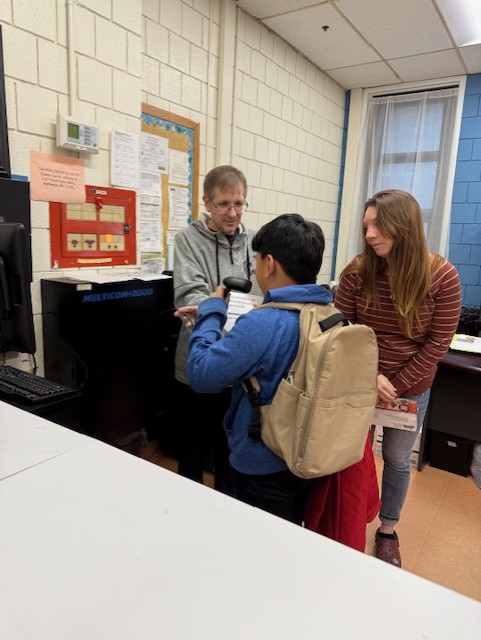
A student completing the morning announcement with Principal Wunder!
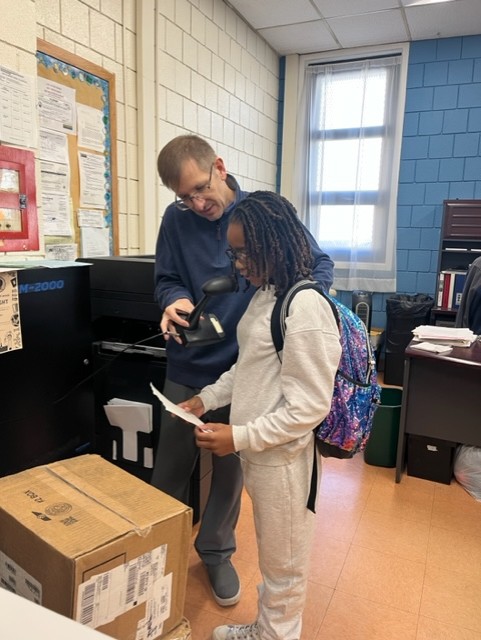
Student with our school secretary getting ready to read the Friday Fact!
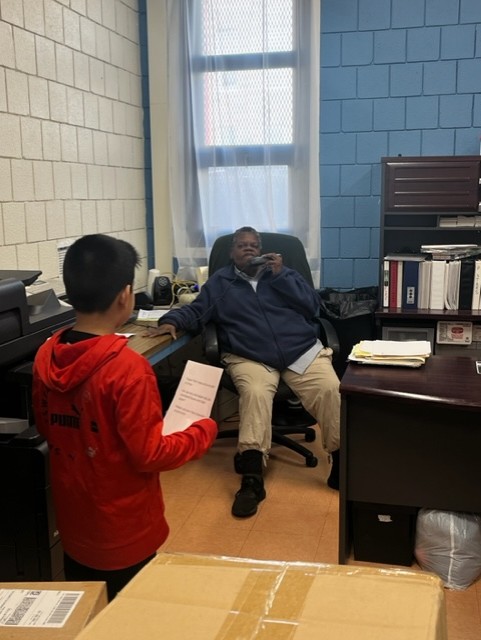
Reading our Friday Fact!
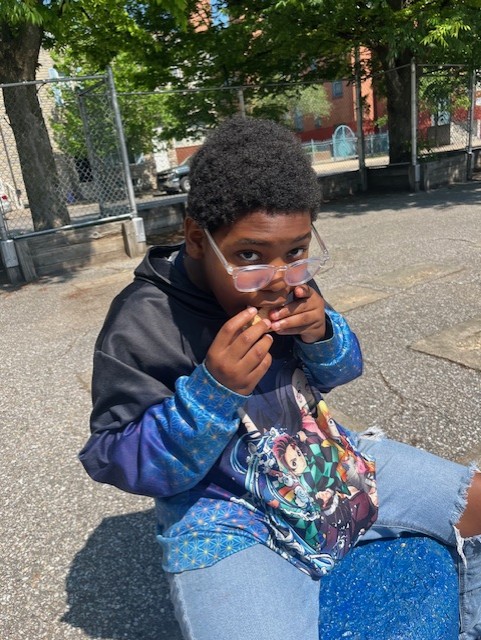
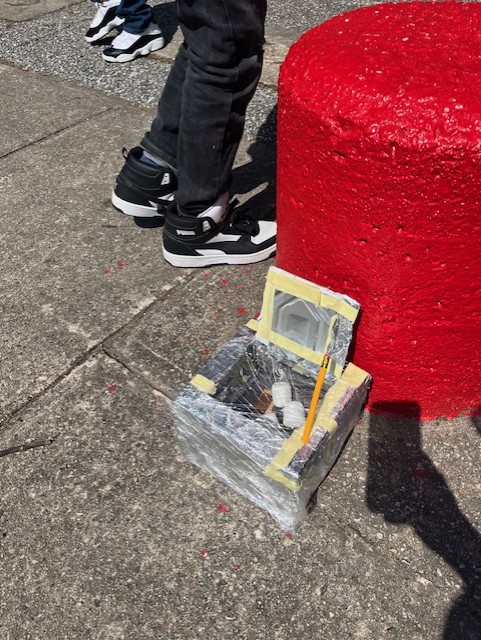
After learning about about alternative energy sources, 5th grade students wanted to come up with alternative solutions to electricity. After a vote, They decided to work with solar energy to 'cook'. Students followed the design engineering process in order to create a design and execute. Students enjoyed a yummy, melted smore. (For many of them it was the first time they ever had one!)
One student who was able to enjoy his 'cooked' s'more.
Here you are able to see that the oven is working as intended
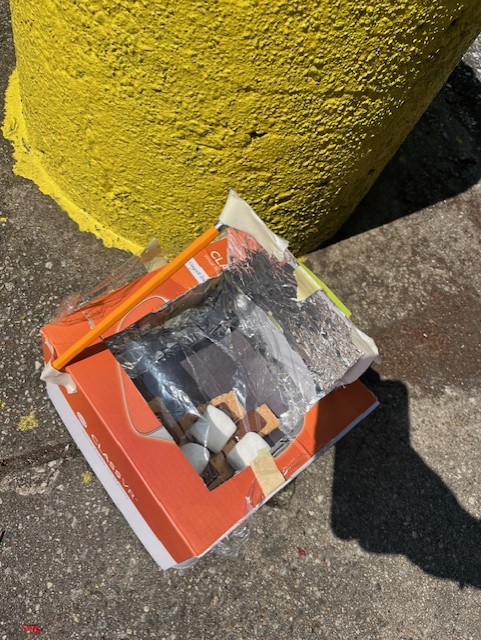
This is one unique example of the solar oven the students created
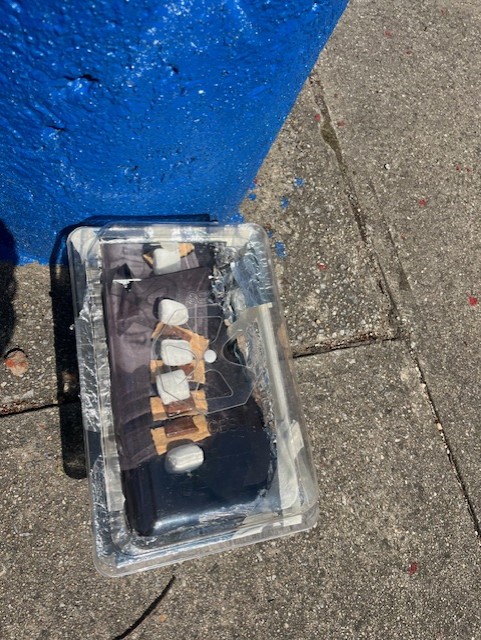
Student making observations about his solar oven. It was hard to be patient.
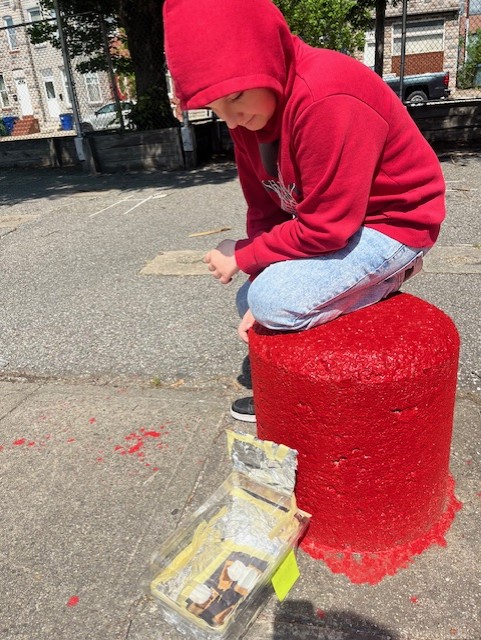
Students were able to observe each others' designs while waiting for the sun to do its work.
Reflections_ My solar Powered Oven (45.96 KB)
Three student reflections about our solar ovens and what possible next steps would be.
2.3 Solid Waste Reduction
2.3 Solid Waste Reduction
This is an on-going student action shared by all the students in the school for breakfast, lunch, and afterschool programing. Students place food and drinks that they do not want on the share table for others. Any items left over are handed out as snacks at the end of the day. Additional fruits after that are donated to a staff member to feed to her chickens!
Students know how and when to use the food share table
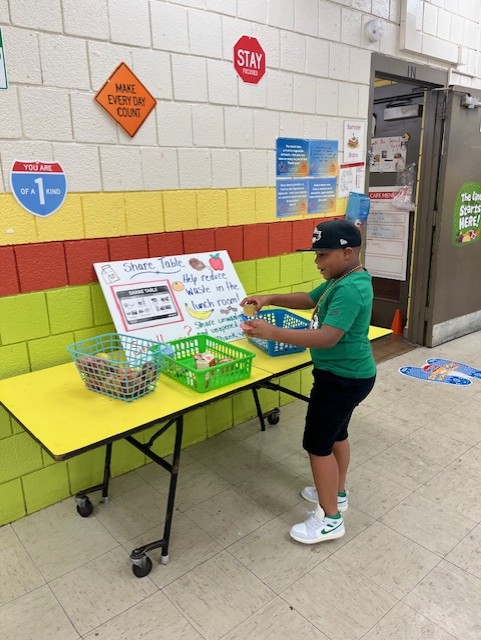
Students using the food share table
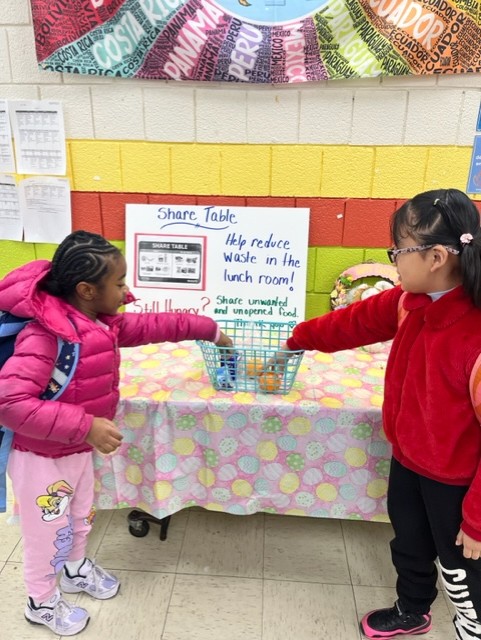
Cafeteria manager email (104.04 KB)
Here the leader of the Green Team shows collaboration with the cafeteria manager to create a culture of food conservation with the students of CCB
2.4 Habitat Restoration
2.4 Habitat Restoration
No records were added by the school.
2.5 Outdoor Learning Structures
2.5 Outdoor Learning Structures
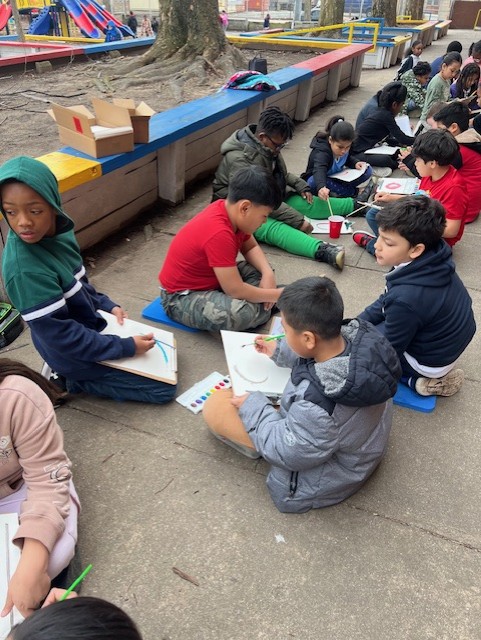
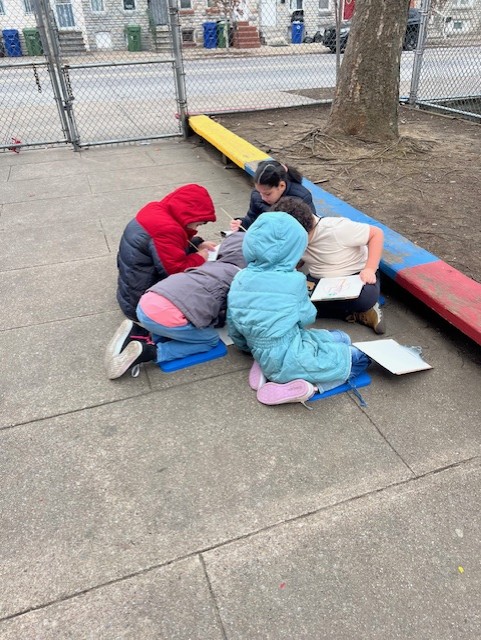
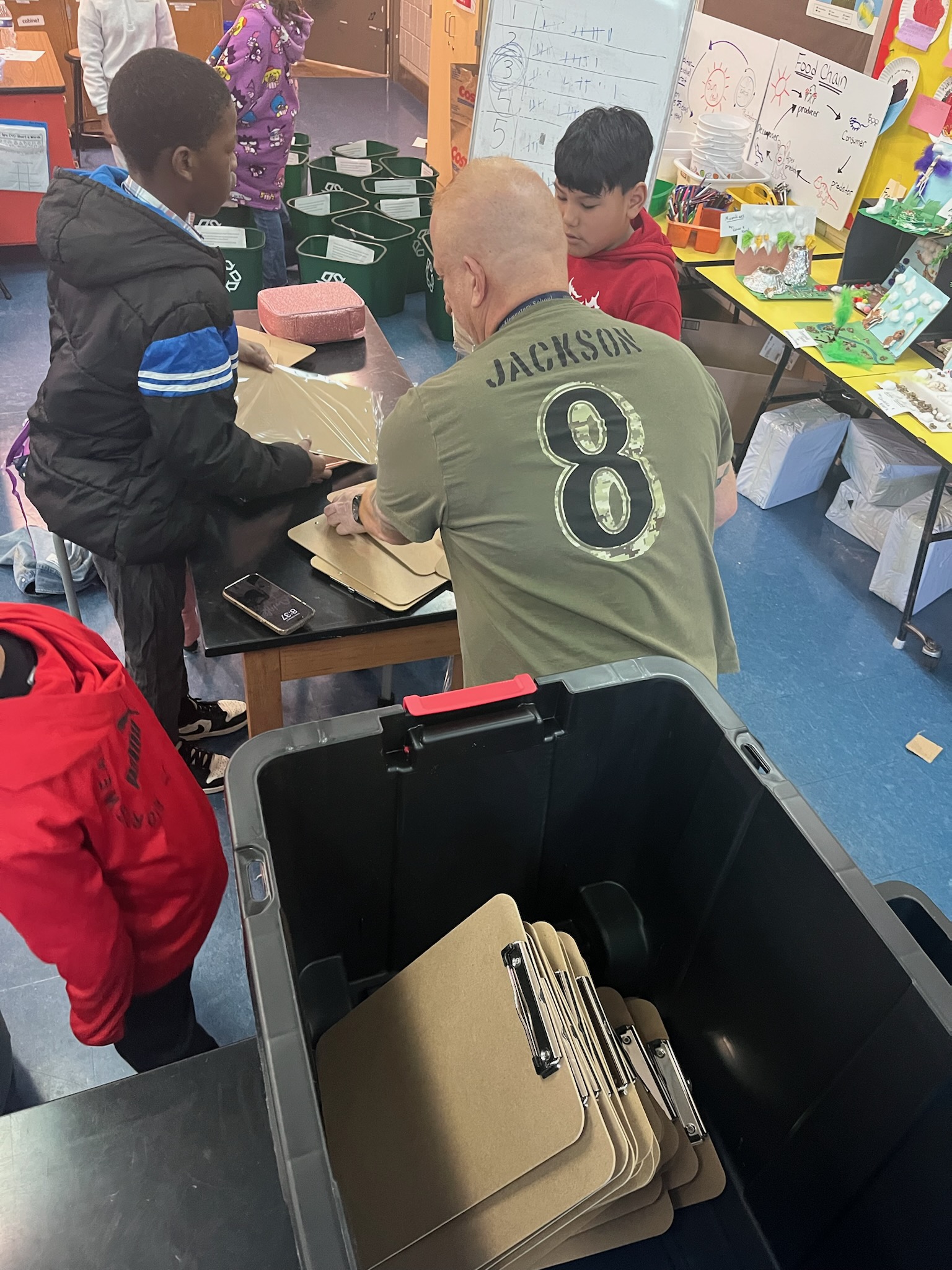
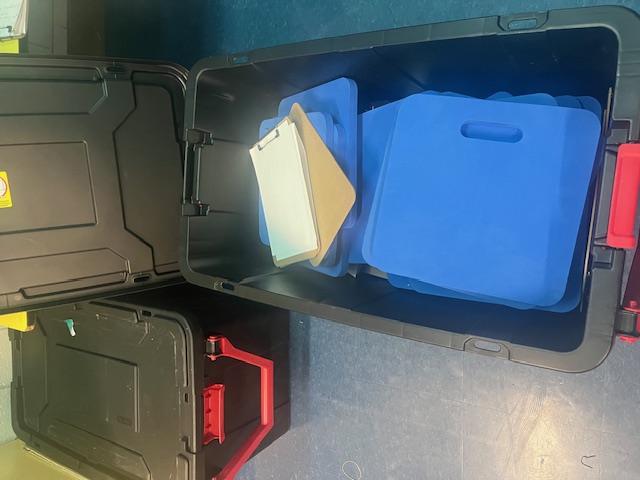
Members of the Green Club wanted to create an outdoor learning space. Unfortunately, a permanent structure was not the right choice for our school due concerns about our surrounding community. As a creative solution the students assembled a portable outdoor classroom complete with sitting pads, clips boards, and sturdy storage containers on wheels. Teachers and students 'sign out' the portable classroom to use for learning experiences on our school campus or to be taken across the street to Carroll Park.
A whole class using the outdoor classroom to complete an 'painted essay' for ELA
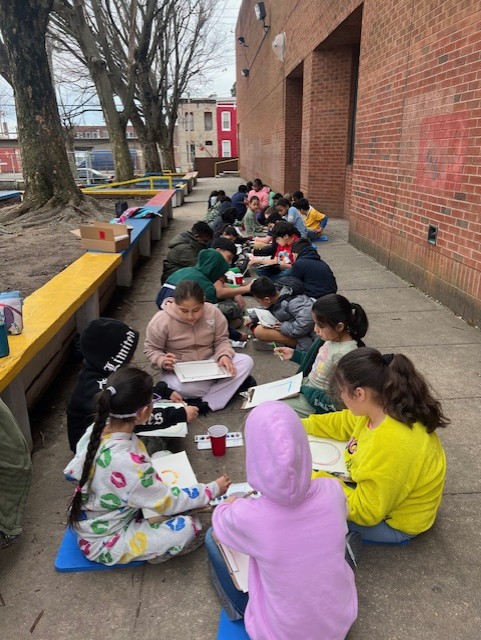
Notice the use of the blue pads to sit on and clip boards to write/draw/paint on.
Here a small group is using the outdoor classroom materials to complete a reading activity.
This picture shows the students and advisor of our green club unpacking the materials purchased for the outdoor classroom.
container that we keep the outdoor classroom sitting pads and clip boards- they are on wheels with a handle for convenience.
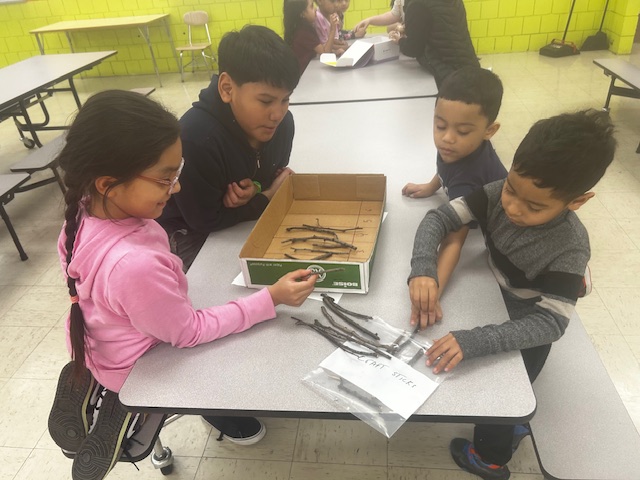
Students/members from Green Club created learning games to play with the kindergarten/ pre-k class. The group used nature materials to make counting, letter recognition, and puzzle games. The older students designed, built, and implemented the games with the younger students. This was also documented in the Pre-k section for 1.1.
Games were made in partners
- Match rocks by shape and color
- Lower and upper case letter matching with rocks
- Games with acorns (3 counting games)
- Spelling words with shells (Consonant-Vowel-Consonant [CVC] words)
- Counting sticks and pairing with number
- Solving leaf puzzles (matching pairs)
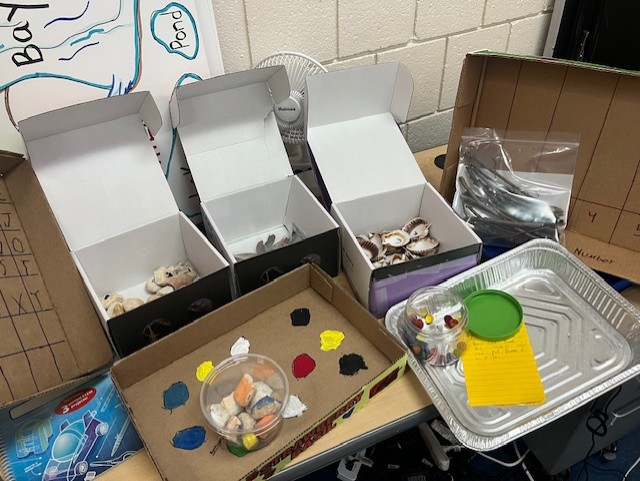
Student traced and painted rocks to help students in pre-k practice their sorting and colors.
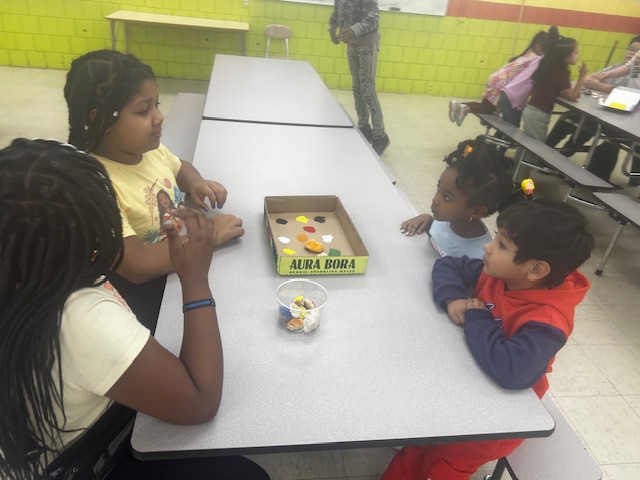
4th and 5th graders sharing their stations with pre-k students
Spelling words with shell letters
Counting with sticks and organizing them based on number sorting.
2.6 Responsible Transportation
2.6 Responsible Transportation
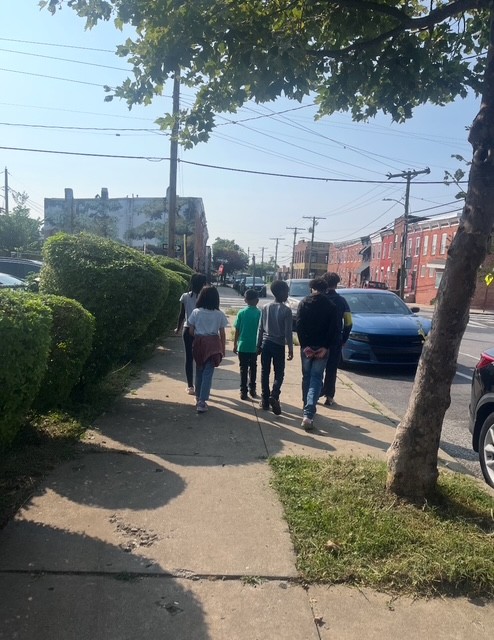
Here at CCB we are centrally located by many great opportunities in downtown Baltimore, which makes it a perfect location for walking field trips. We are able to reduce carbon emissions by not using buses. This artifact describes several walking field trips:
- The Gifted and Advance Learning (GAL) students in 3rd and 4th grade walked a weekly workshop (every Friday) learning about the tools and projects the scientists at Early Charm are developing (https://www.earlycharm.com/)
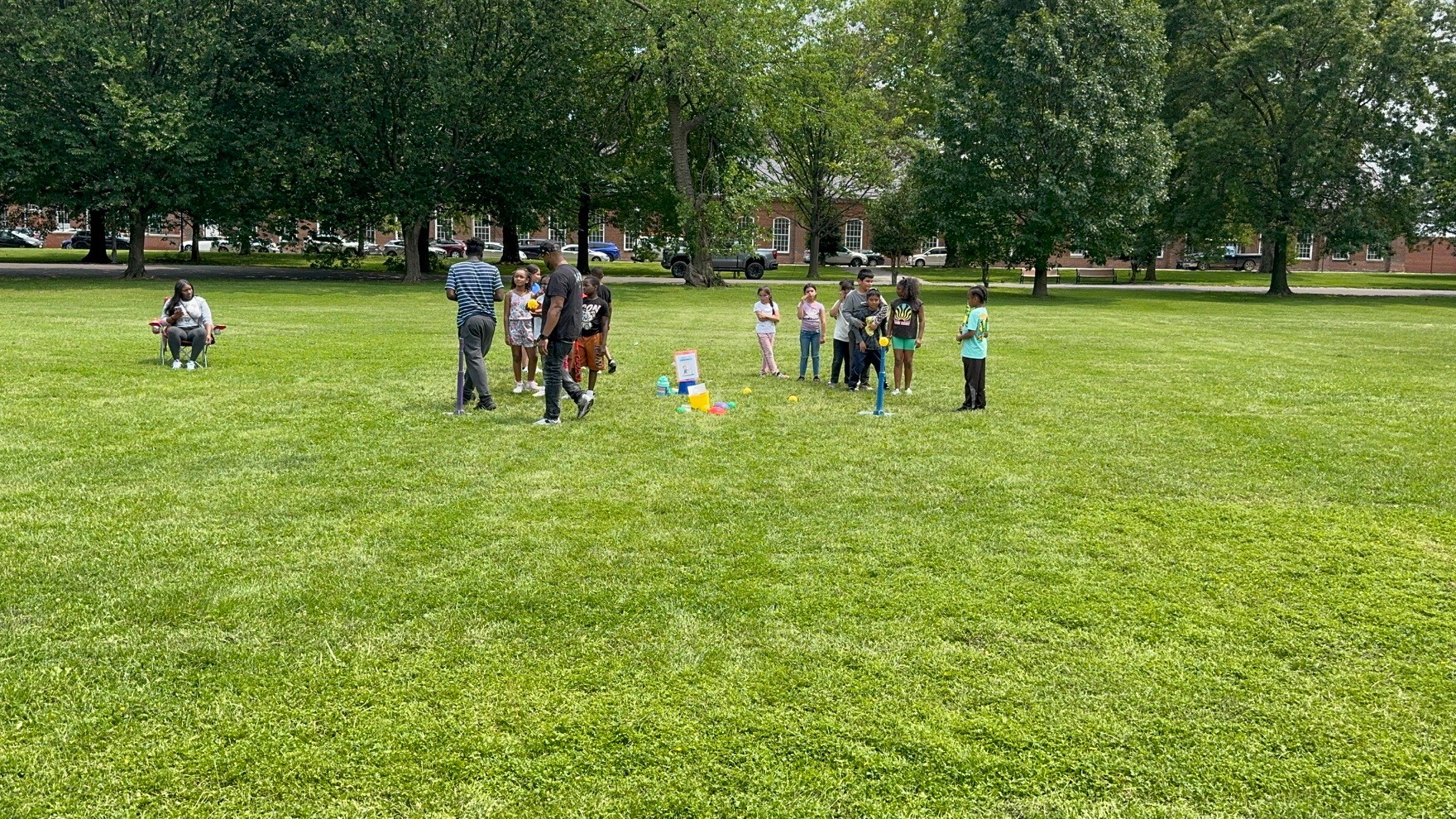
- The entire school walks to Carroll Park for Field Day since we don't have open space on our school grounds.
- Our Green Club enjoys walking field trips to the park and neighborhood gardens.
GAL students participating in 3-D printing at a local engineering company- Early Charm - students walk here each Friday.
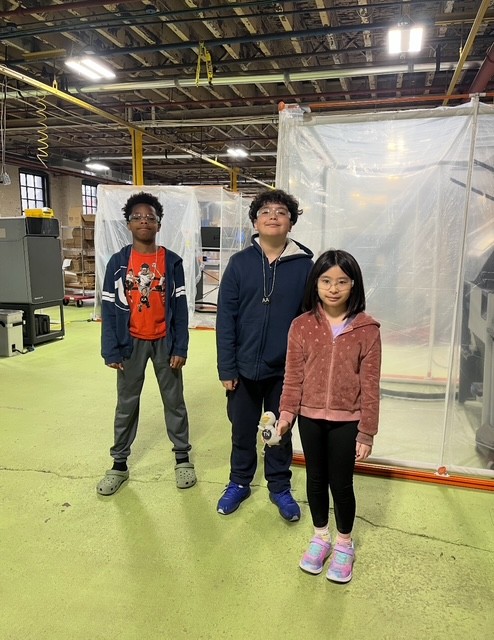
Student walking to their weekly 3-D printing lessons
Students enjoying field day after we walked to the local park. We do not have a field at our school so we walk to Carroll Park in order to have our field day!
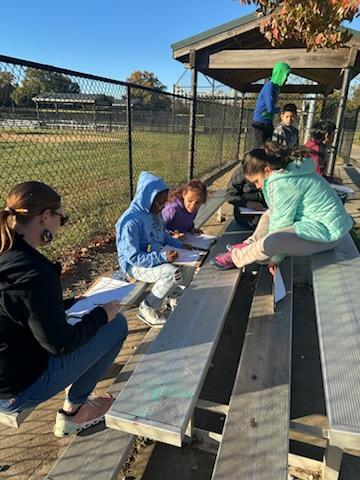
Green Club using local park to document different trees
Green Club enjoying local park
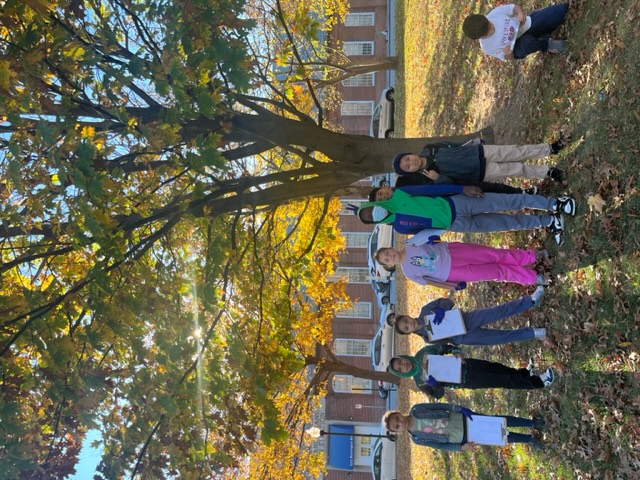
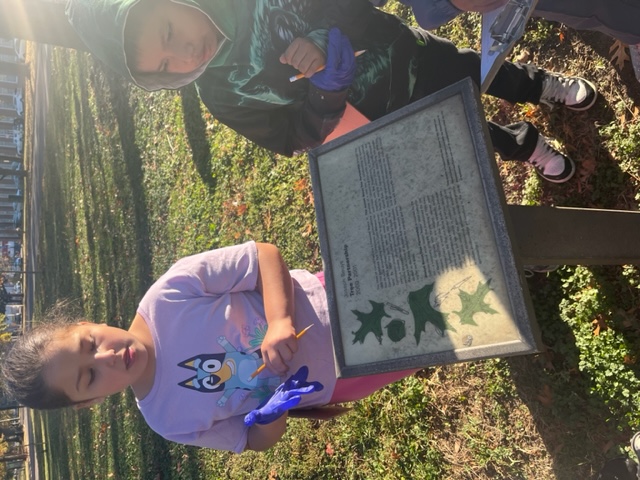
Tree learning walk to local park, students enjoyed learning that Carrol Park was meant to be a place for trees in the city!
Walking Field Trip permission slip log for school (342.97 KB)
The screen shot of this document is to show how our administration tracks students that have turned in their walking field trip slip each year. We do so many walking field trips we get them turned in by all of the students at the beginning of the year.
2.7 Healthy Indoor Environments
2.7 Healthy Indoor Environments
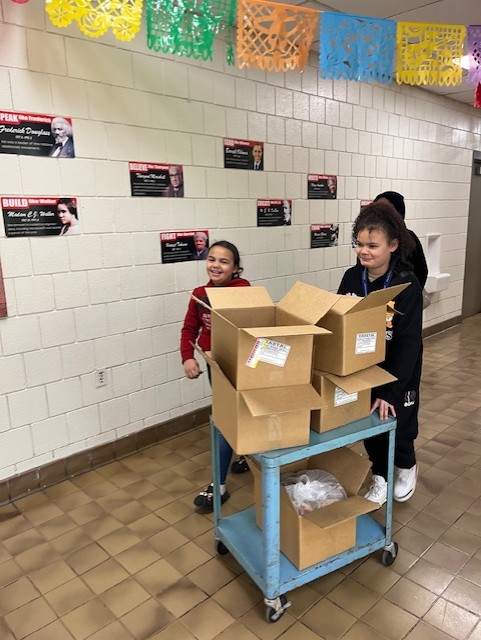
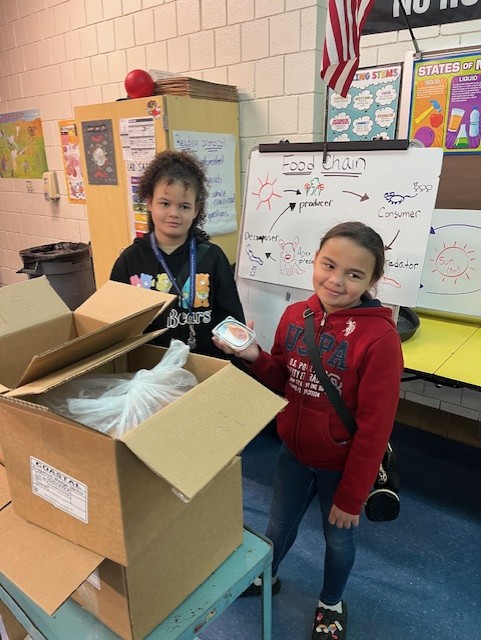
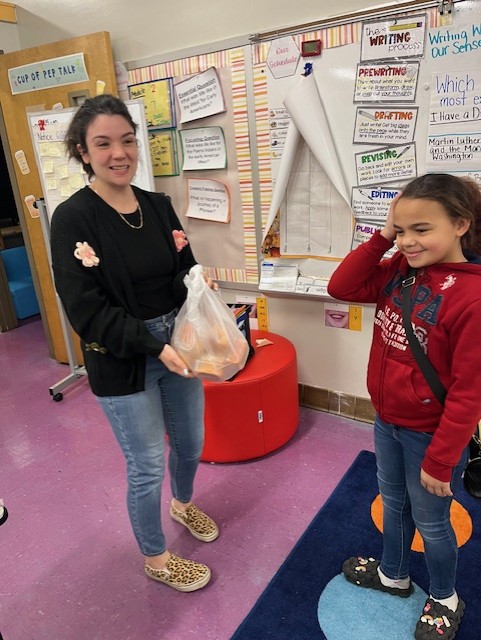
Throughout the year a team of students lead the distribution of healthy foods and fruit received by community partners. Students prepare foods for the class homerooms and bring them to the classrooms. The food choices are always healthy foods. Then the student from the classroom hand out the fresh fruit to the students.
Students delivering fresh fruit. We do have the same students complete the delivery each week.
Students receiving this week's fruit delivery
Teacher receiving the fresh fruit delivery from our team of students.
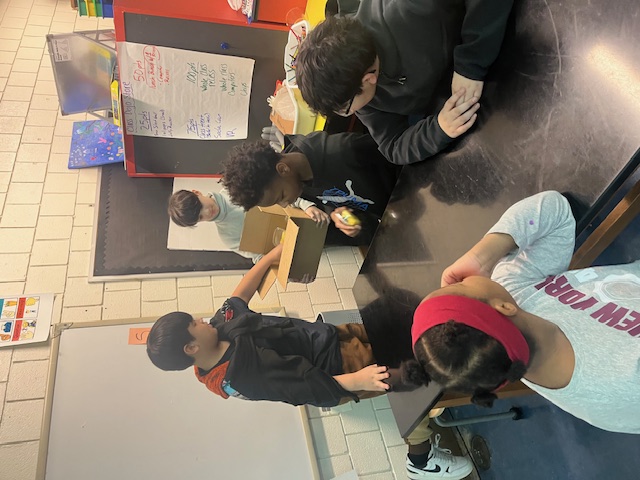
Student giving out the fresh fruit at the end of the day
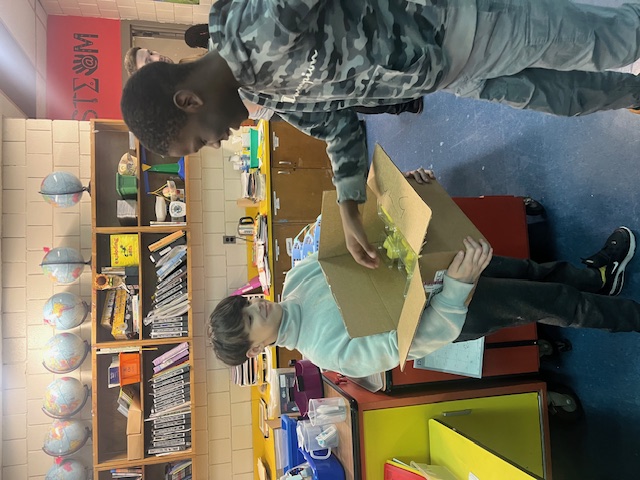
Students working together to pass out fresh fruit at the end of the day
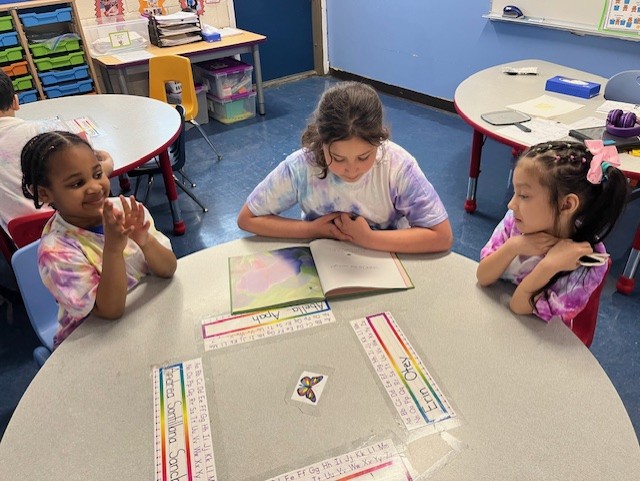
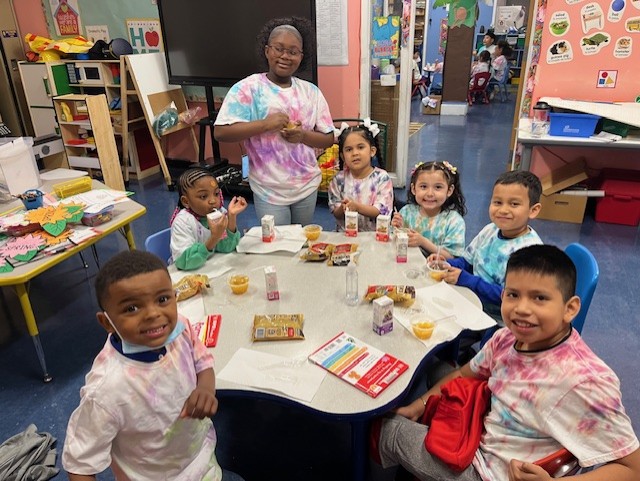
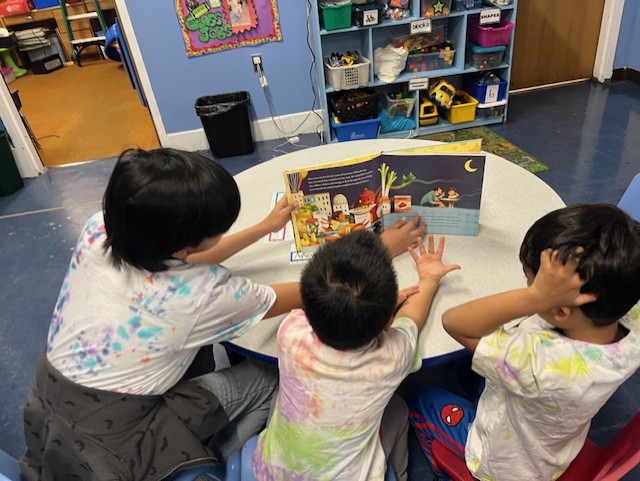
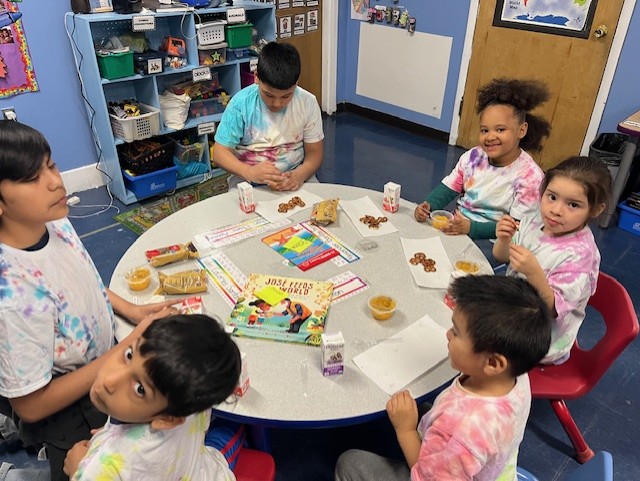
Our Green Club wanted to work with the youngest group of students at our school, Pre-K. Green club consists of students in 3rd-5th grades. They had tie-dyed their own shirts in green club and had a lot of fun, so they developed a plan to tie-dye shirts for the Pre-k students, read books about heathy choices, and share a heathy snack with them. Through food pantry donations and collaboration with the librarian, students joined the pre-k for over an hour to share the shirts, read them books, and eat healthy snacks together!
In matching tie-dye shirts the Green Club 4th and 5th graders read to the pre-k students about healthy choices
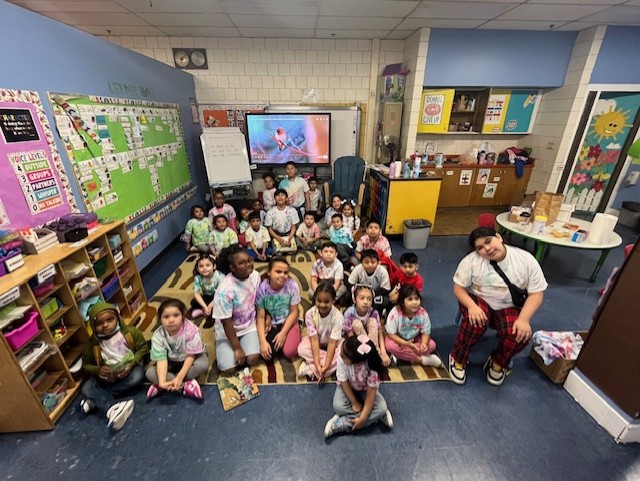
Group picture of our pre-K buddies!
Sharing a healthy snack
Students reading to the younger children about the environment and healthy eating
The older students showed a lot of responsibility by opening items for the younger students and working together
2.8 Participatory/Community Science
2.8 Participatory/Community Science
No records were added by the school.
Community Partnerships
Demonstrate that your school is forming long-term partnerships to foster environmental stewardship and cultivate community wellness through real-world connections.
3.1 Community Partnerships
3.1.1 School Active in the Community
Describe at least one environmentally-focused partnership in which your school is working to benefit your community.
Acceptable Documentation: Photos, newsletters, or social media highlighting students participating in an environmental service project such as a local park conservation project, harvesting produce from a farm or school garden to be donated to a food bank, holding a recurring used clothing drive or book swap for the community, or visiting another school to teach other students about the environment.
8/25 - Present Last year our green club only cleaned up around our school grounds. This year we were able to form a new partnership with the Friends of Carroll Park, a non-profit organization working to keep Carroll Park up and running for the surrounding neighborhood: https://www.friendsofcarrollpark.org/
We were able to reach out and started coming to the park each Thursday morning for trash pick ups. This made a big difference for the students and the park. This would be considered long term because we go each Thursday - it will have been happening for 7 months when this application is submitted.
Carroll park is our school's closest green space and the students love be a part of this partnership
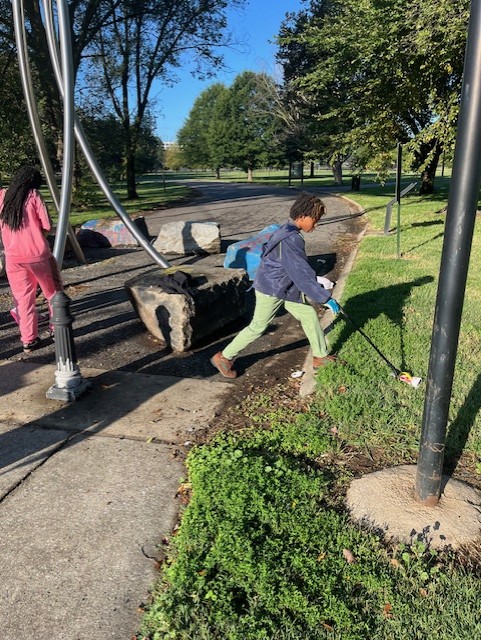
Two of our green club members walking to pick up trash
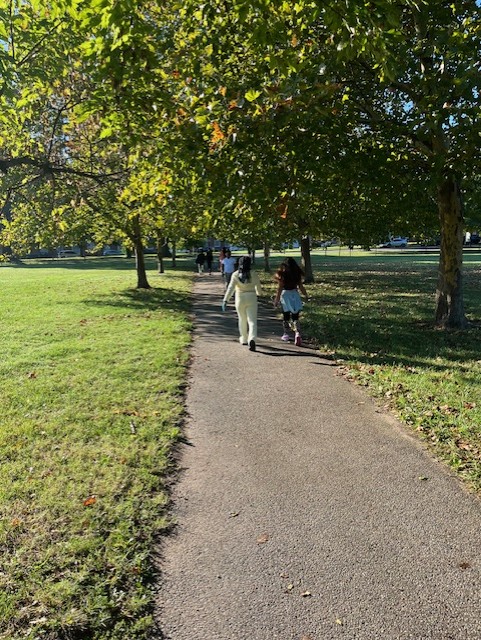
The group wants to go every Thursday- rain or shine!
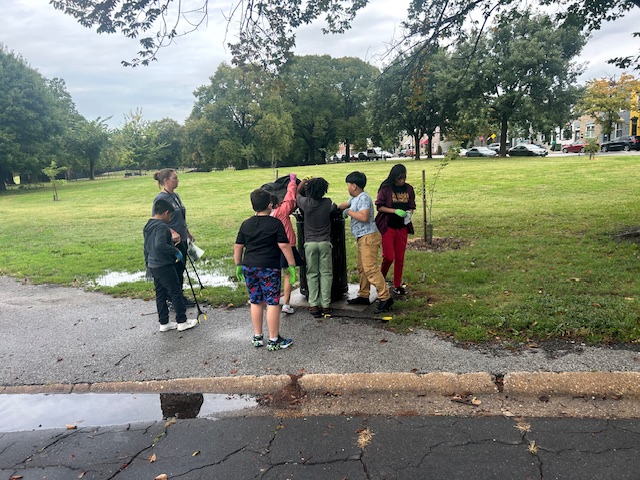
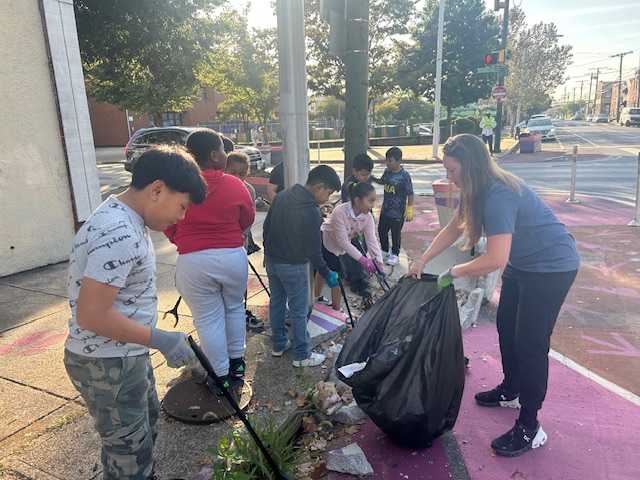
Often the surrounding trash cans/other vessels are knocked over and require special attention. This trash pile had been on this corner for several days - the students were proud of the clean up.
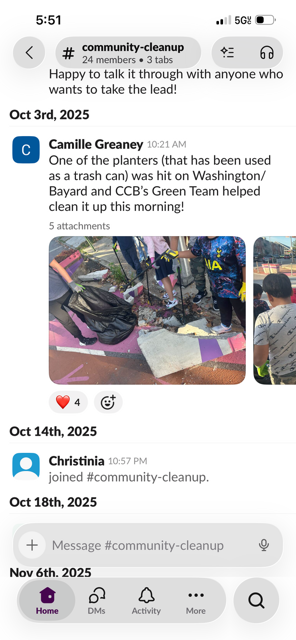
This is a post on social media about our green team clean up with the Friends of Carroll Park
Friends of park follow up email (218.02 KB)
This is the response from the president of Friends of Carroll Park - excited about the beginning of our partnership!
We are very fortunate because Camille Greaney is the president of Friends of Carroll Park and also a 2nd grade teacher here at CCB. This has made the partnership strong and seamless in our communication.
friendsof park 1st email (103.29 KB)
This was the first email sent to initiate the partnership in the beginning of the 2025-2026 school year.
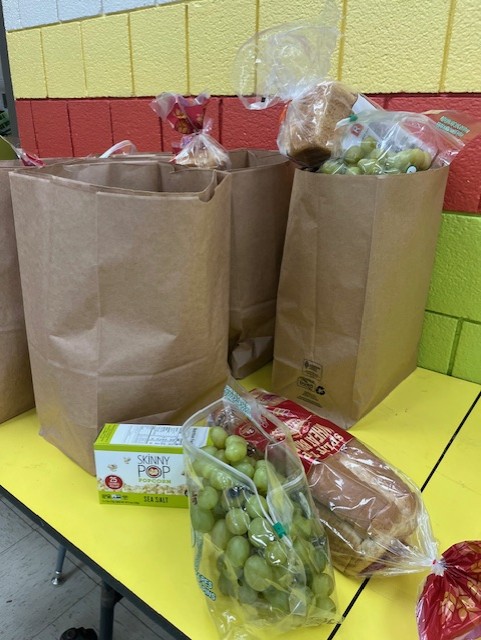
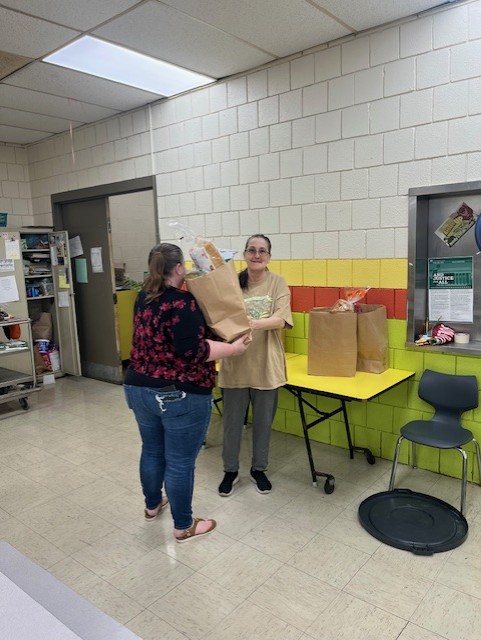
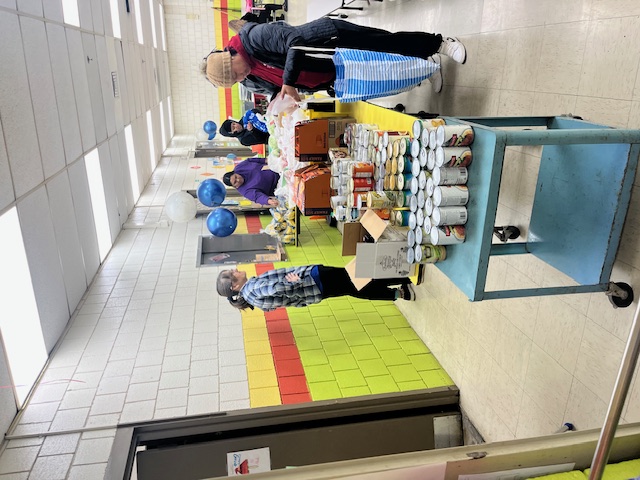
10/2024 - Present Our school has been working for years and years with the local food pantry and its partners. Community members are able to come in often, several times a month to receive healthy food options. https://sowhatelse.org/ is a non-profit that works with local schools to bring surplus food. This cuts down on food waste and provides healthy options for the community members. Bon Secours is a part of our school community outreach that supports this opportunity. Our families appreciate the consistency of food availability.
We have an amazing volunteer who has been helping coordinate and pack up the food for the community for over 30 years! She does a great job of making sure everything is set up nicely for our families
Ms. Burney handing out the food to a local parent
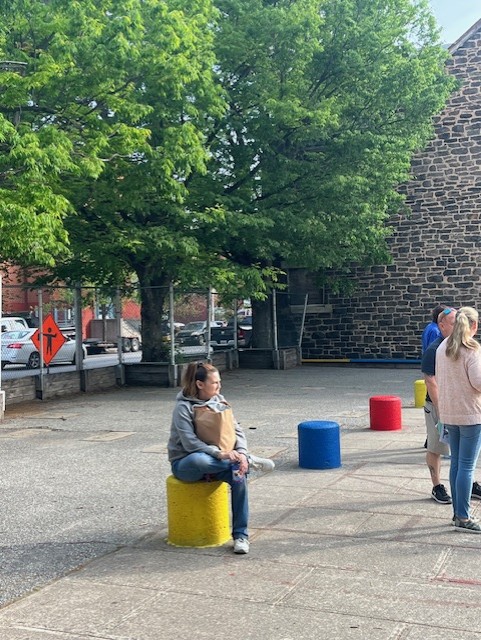
This parent is waiting for her student after being able to get food from the delivery.
This is the set up that Ms. Burney provides each week. She has volunteered at CCB for over 30 years and takes pride in being able to provide these healthy food options to our parents and community.
Food Delivery multiple pictures (12.25 MB)
This PDF has multiple photos of a food delivery from SoWhatElse.org
Food Bank Email (357.22 KB)
This email was provided by our community school coordinator who works closely with our partners and shows the re-establishment of our partnership for the 2025-26 year and the group's next steps of setting up a calendar for on-going deliveries.
3.1 Schedule and on-going partnership (330.62 KB)
This email outlines that we will receive a delivery each Thursday but also accounts for days we are not in school. The on-going partnership is clearly outlined with this scheduled commitment to our community members.
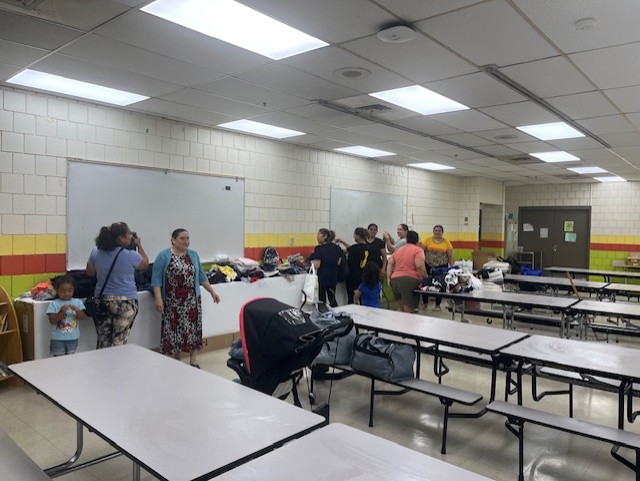
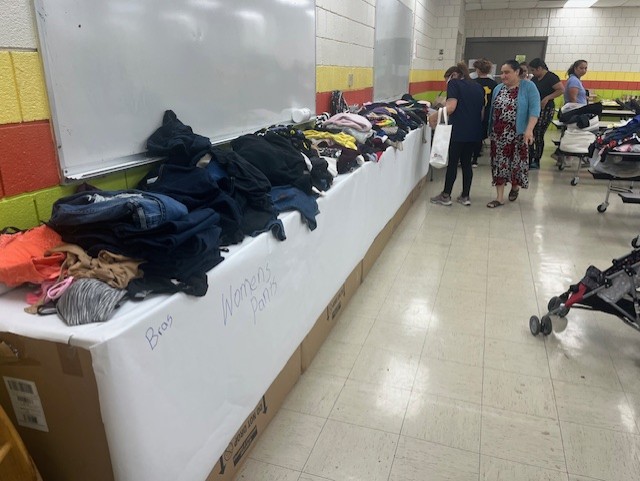
Ms. Duffy, our Engligh Language Learning (ELL) educational lead has supported the school in an on-going relationship with a group of parents. This partnership has been reciprocal and will be mentioned again in 3.1.2. Throughout the year the school staff support this organization by holding several clothing drives - typically in the fall and spring. The staff brings in clothes that can be donated and reused by our families. This sustainable practice of reusing goods supports the green school initiative and our community.
Community coming out for our clothing drive
Organized clothing for the community
Clothing Drive Monday Message June 02nd 2025 (292.94 KB)
Documentation of our Spring 2025 clothing give away
3.1.2 Community Active in the School
Describe at least one partnership in which a community partner (different from the systemic partner listed in 1.4.2) is providing any type of Green School services to the school that occur within the classroom, school building, or on school grounds.
Acceptable Documentation: Photos, newsletters, or social media highlighting a local business providing funding or in-kind donations for environmental activities, organizations delivering classroom presentations or assemblies on environmental topics, or organizations assisting with school campus projects such as tree plantings and bird box installations.
CCB and TasteWise kids have partnered over many years to provide students with unique opportunities in sustainability and healthy eating.
-
TasteWise Kids' Days of Taste (DOT) is where students learn about healthy eating in the classroom, go on a field trip to their farm, and make salads at school with a local chef. Attached documentation shows the on-going partnership with our school for the past 3 years
-
TasteWise Kids and CCB collaborated to bring a school-wide Earth Day celebration in 2025. We plan to work with them again in Spring of 2026.
-
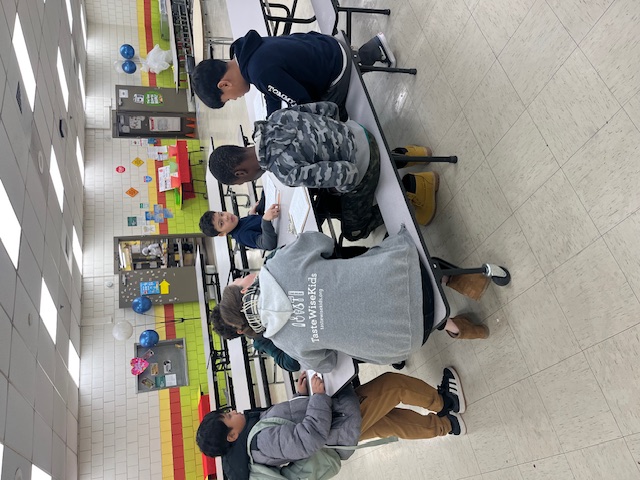
Working with our green club members to do an audit of our school and an action project.
School-wide Earth Day promise board made in collaboration with TasteWise Kids. Spring of 2025 Earth Day
Fall of 2024 Days of Taste
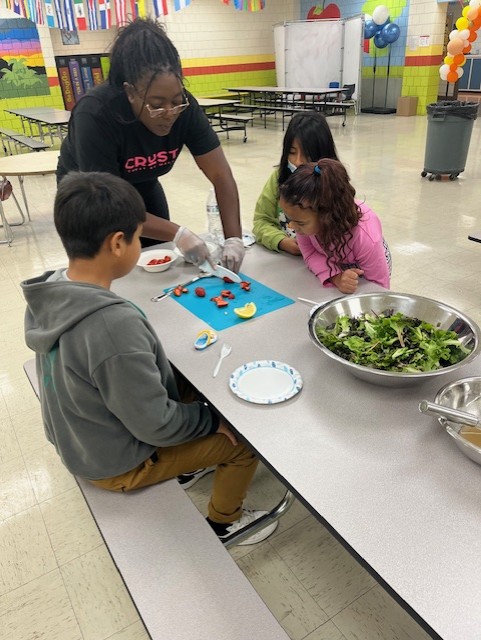
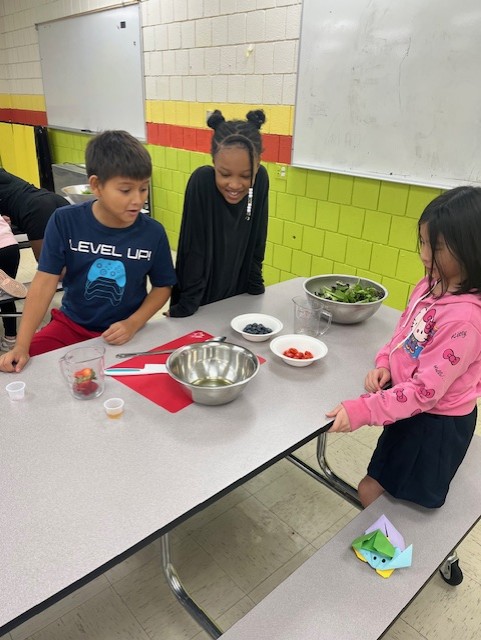
Students learning about salad prep and enjoying hands on knife skills with healthy foods to make a yummy dish
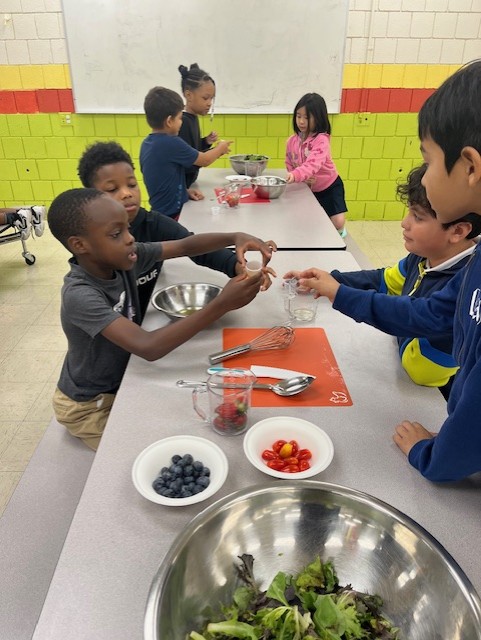
Students pointing to their TasteWise Healthy Eating stickers
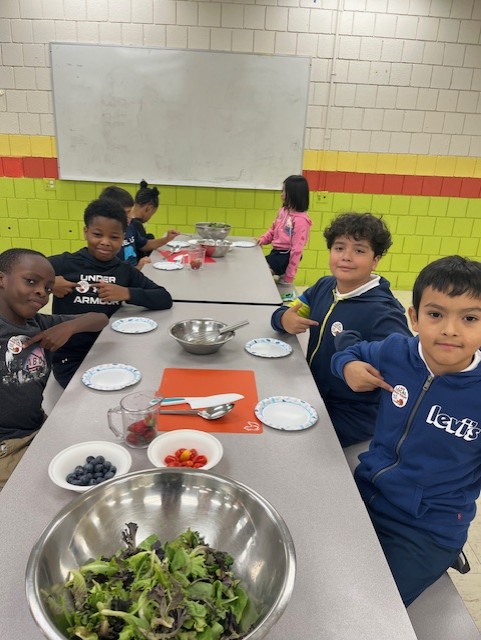
Students excited by fresh ingredients.
Here a representative from TasteWise Kids is working with some of the students in our Green Club. This will be an ongoing partnership as they will come back at least 5 more times and complete an action project with our green club students.
ongoing partnership DOT (156.76 KB)
This email is between the lead teacher of CCB and our community coordinator. They are collaborating to bring TasteWise Kids back to our school for the Days of taste program for the 2nd year in a row. The email is dated Aug 2024 and references how much fun the 5th grade had 'last year' with the program. This is evidence of the partnership occurring in the Fall of 2023 and Fall 2024. This this program continued for student this past fall 2025.
Earth Day Email collaboration (498.34 KB)
This email serves as evidence of on-going partnership as TasteWise Kids have supported CCB with multiple programs. This is from Earth Day 2025
Days of Taste Fall 2025 confirmation (488.46 KB)
This email confirms that the Days of Taste program came back for the third year to our students at CCB
Earth Day 2026 Confirmation (599.12 KB)
Please see the information circled in red to confirm that CCB will be working with Taste Wise Kids once again for our Earth Day Celebration
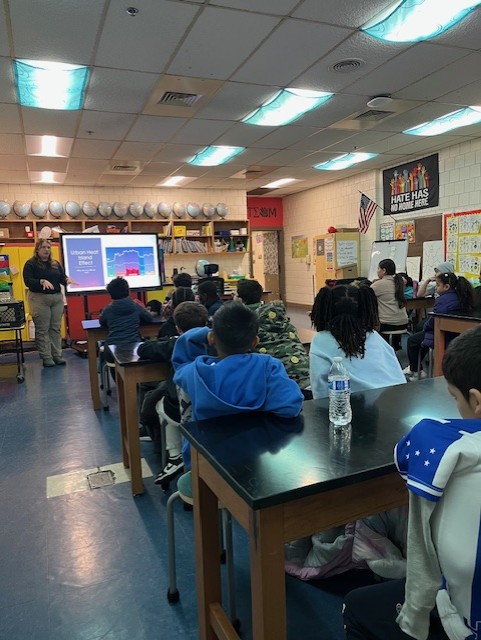
Masonville Cove and the Living Classroom Foundation has supported environmental learning at CCB over the past two years. In the 2024-25 school year, they reach out because they had partnered with CCB in the past. Looking to continue that partnership we collaborated to bring a program for 3rd grade into the school. The students learned about Urban Heat and how this applies to their lives.
This year, 2025-26, we are collaborating to bring on-going learning experiences to 4th and 5th grade. This program will span over several sessions, taught by the science teacher and Living Classrooms - resulting in a field trip to Masonville Cove for those students at the end of the year.
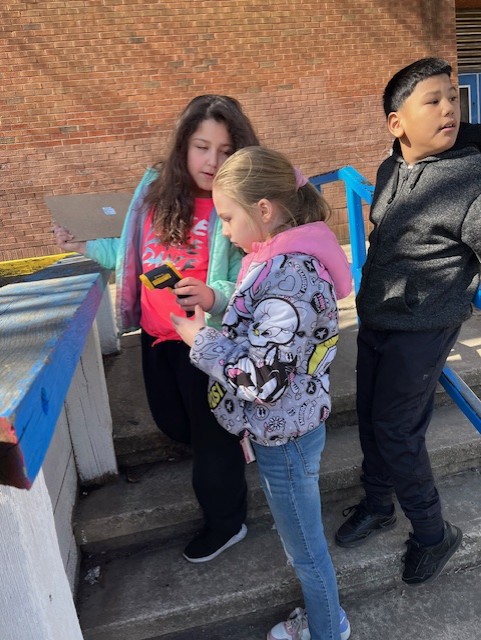
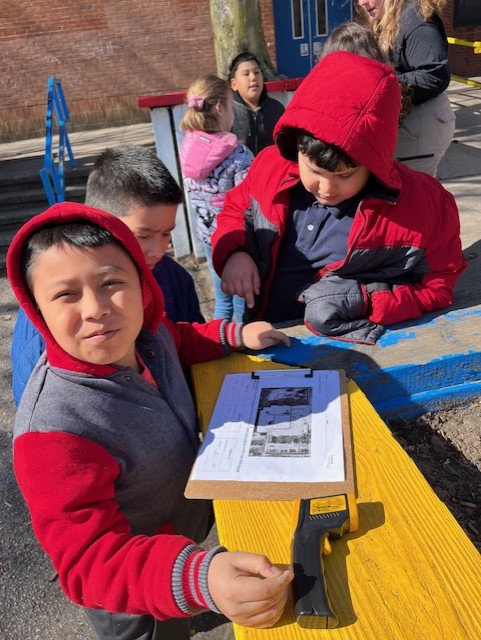
In the spring of 2025 students collected heat data as they learned more about urban heat
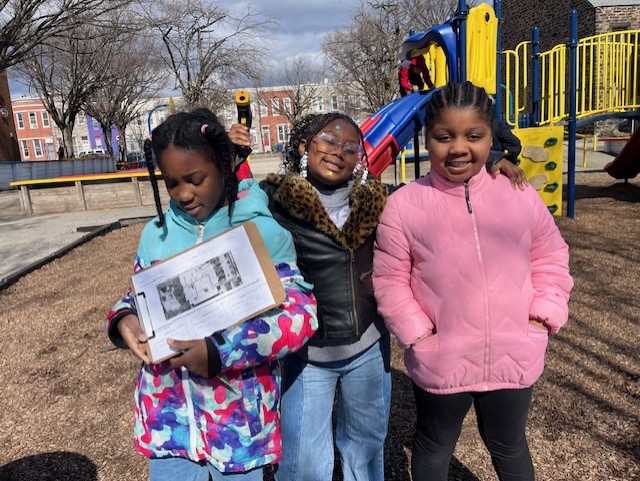
Outdoors with materials to collect heat data around our playground surfaces Spring 2025
This is documentation of the classroom piece of this lesson spring 2025
The classroom part of the lesson extended to the outdoors where students analyzed urban heat on our playground surfaces. Spring 2025
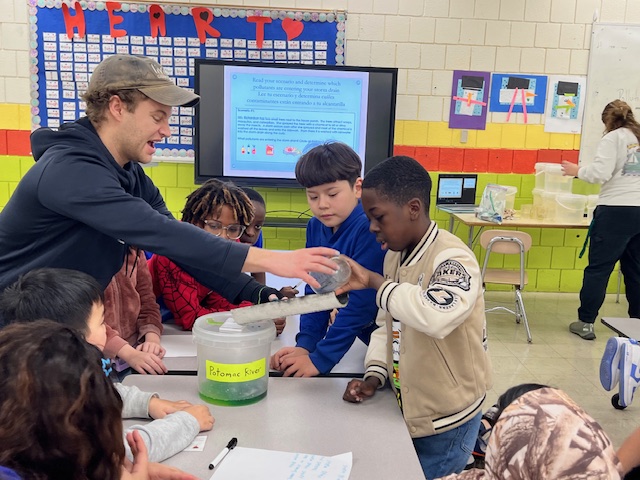
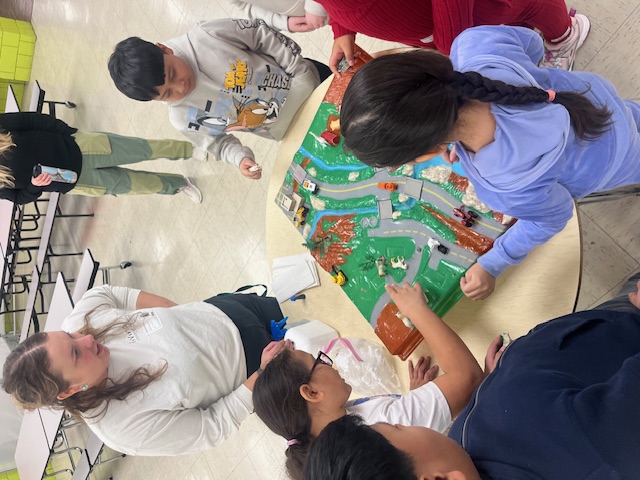
5th grade modeling how storm drains work Winter 2026
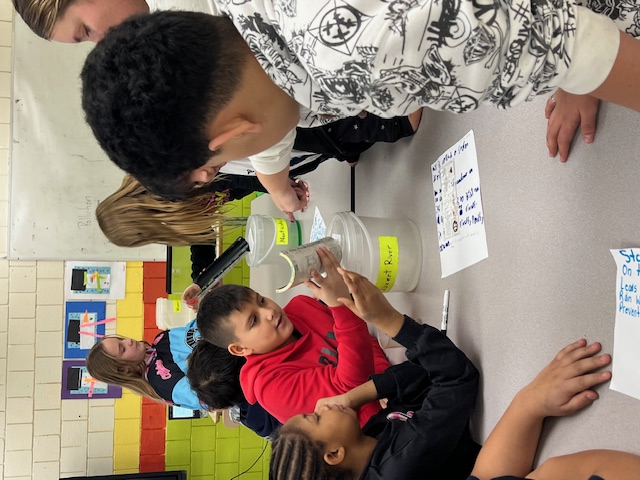
5th grade getting hands on to learn about storm drains Winter 2026
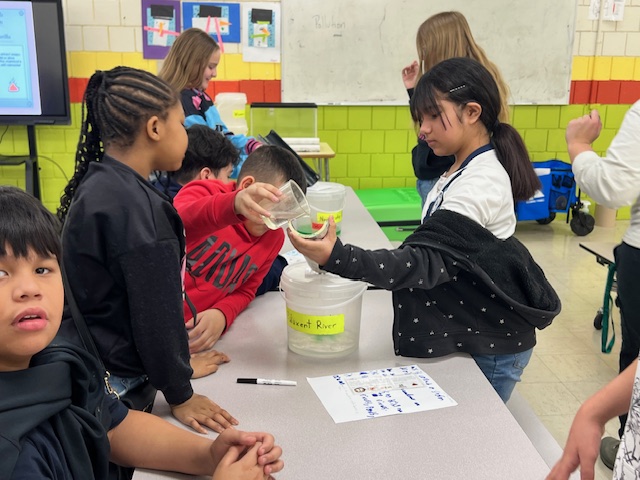
5th grade learning about storm drains and pollution Winter 2026
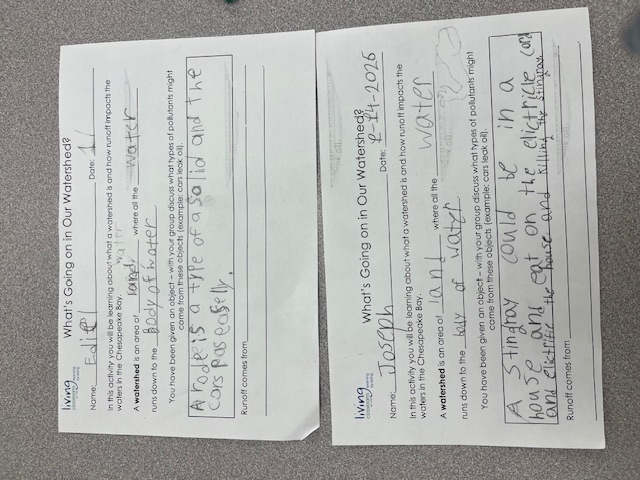
4th grade student work from the program
4th grade learning about pollution in the watershed
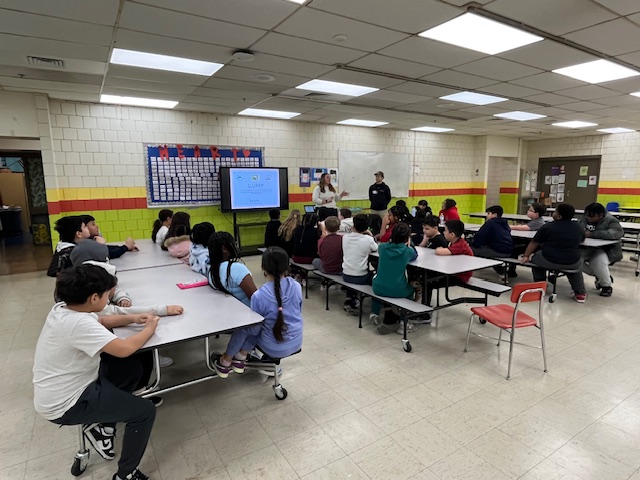
We combined our 4th grade classes for the morning program and use the cafeteria for the larger space.
Masonvill Cove 11.15 email (193.63 KB)
emails in fall of 2025 which show on-going partnership between our school and Masonville Cove / Living classrooms. They are reaching out to work with our students once again this year.
Masonville Cove 3.5 email (257.99 KB)
Grace from Living Classrooms reaching out to initiate this partnership
Masonville Cove 3.25 email (300.03 KB)
These emails display the coordination needed to have outside organizations come to support our students during the school day
Masonville Cove 12.5 email (318.94 KB)
As detailed in the email, this program will be on-going for the students, instead of a one day program like last year. The students will work with Masonville Cove several times and be able to go to their facility!
3.2 Additional Achievements
3.2 Additional Achievements optional
Share any environmentally-related awards, special recognition, certifications, or other achievements that your school, staff or students have accomplished.
Our school was awarded $2500 through the Green Healthy Smart Challenge. We were supported by the National Aquarium and the Baltimore City Office of Sustainability for this honor. These funds helped support our Green Club and the students efforts to start:
- Portable outdoor classroom
- Recycling bins for every classroom
- Tools such as grabbers and gloves for trash pick ups
- An outdoor learning experience for the 14 members to Genesee Valley Outdoor Learning Center *** At the time of submitting this application we were told that we also will receive the funds this spring as well!
This was our Green Club bulletin board that outlined our year- which was funded by this award.
__20250612152365.jpg)
GHSC SY25_Charles Carroll Barrister_2024.01.15 (64.94 KB)
Confirmation of money received from award
Our school was able to collaborate with South Baltimore Gateway Partnership (https://sbgpartnership.org/). They had funding and an outreach effort with Pinehurst Landscaping. Together, over the course of several months, we coordinated the effort to landscape the gardens at CCB.
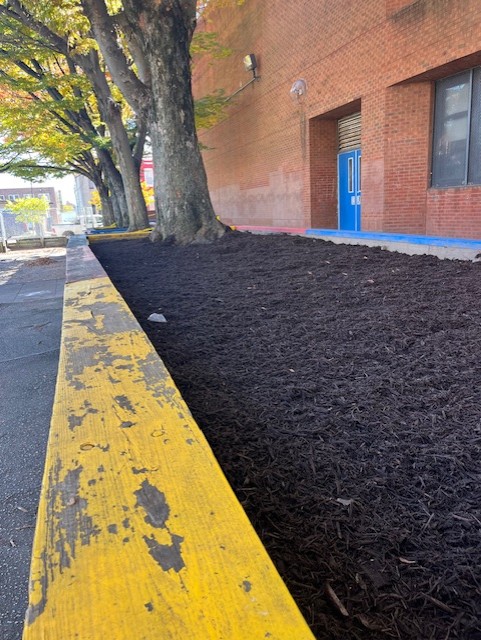
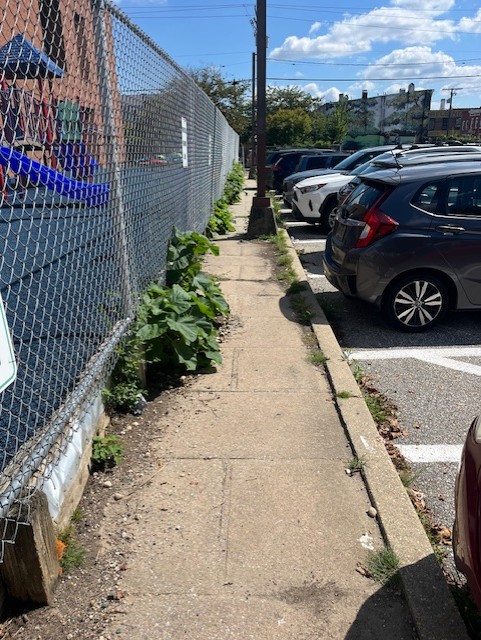
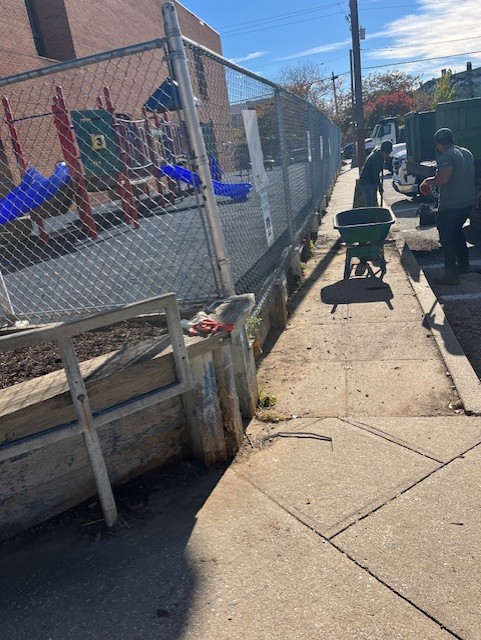
Our partnership with both of these groups continues. But this one day does shine bright which is seen in the before and after photos. The group was able to weed our gardens, lay weed block, mulch, plant native trees, and even supported us with a drain issue that would cause flooding to our playground when it rained.
The crew of Pinehurst were able to bring out several crews to weed the beds, lay weed blocker and re-mulch
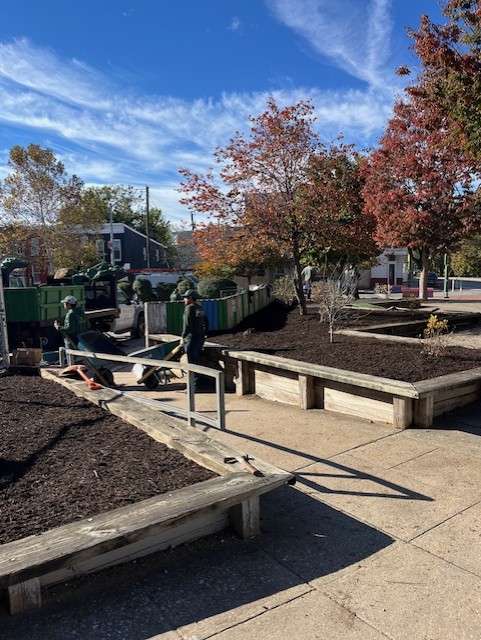
They were also able to plant native, sustainable shrubbery to help with our front garden.
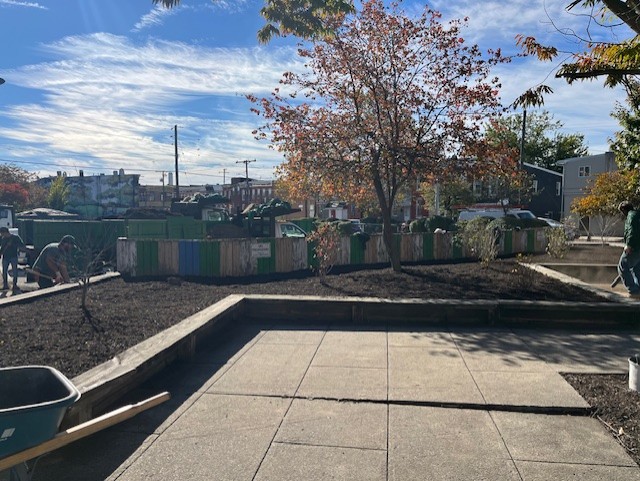
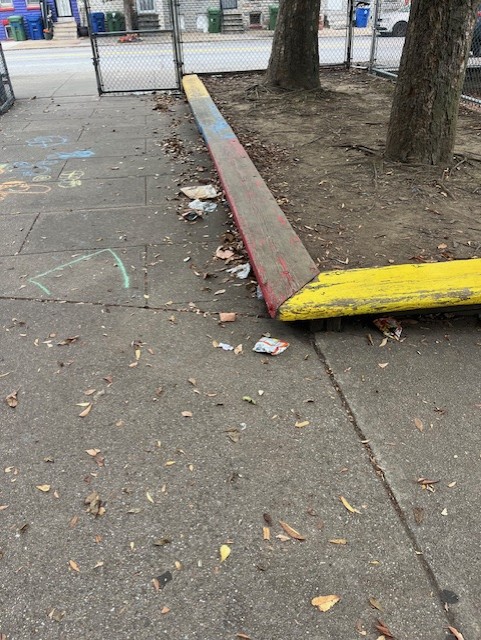
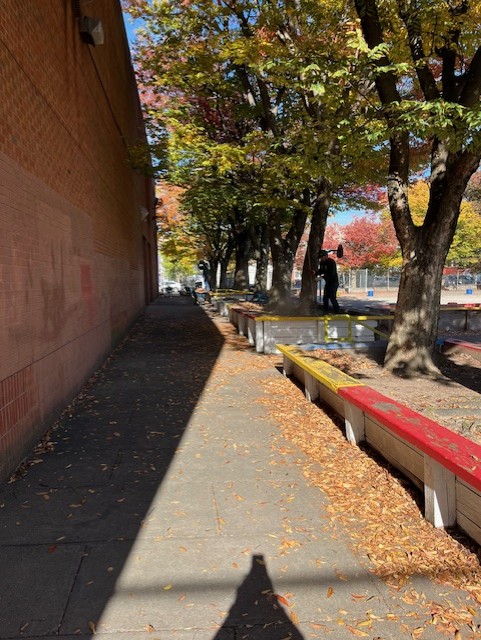
For years these back garden beds were just down to the dirt. Now they have some fresh mulch!
Over growth not cut by City Schools Grounds Shop...
Garden beds prior to re-mulching
Back play before
Pinehurst hard at work!
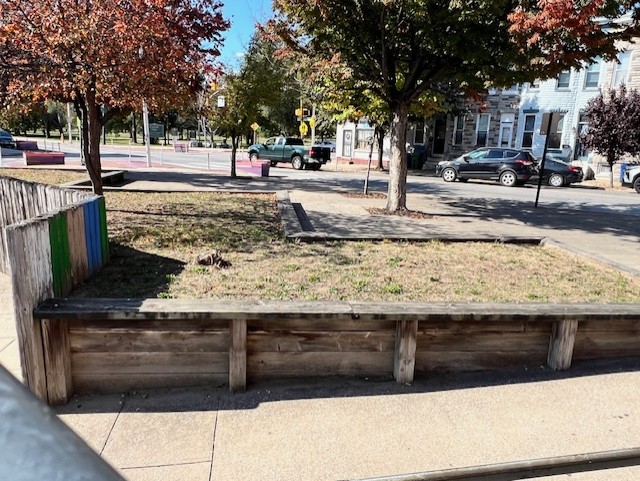
This is the front bed prior to our glow up day!
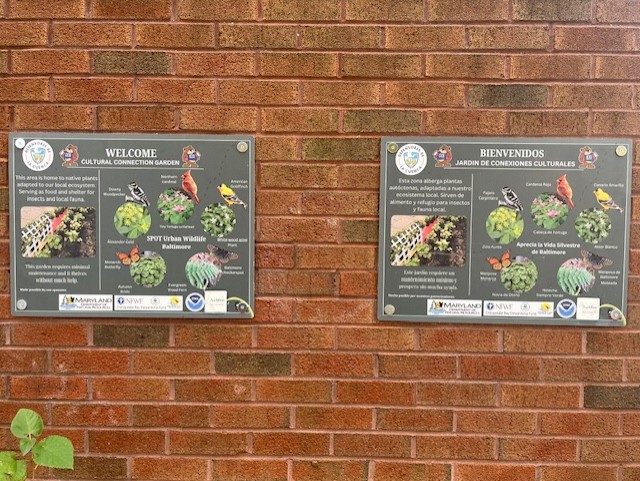
We have an active parent group who created a butterfly garden in the back of our school. They came in on a Saturday and did it all! Unfortunately, I do not have pictures or emails for evidence. This special garden and the plate on the wall was included as an award!
At the time of photographing the garden in was very late fall. This spring the plants should come back nicely.
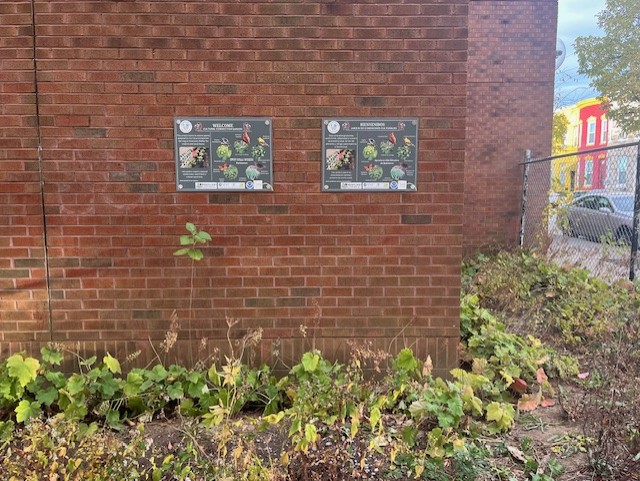
The plates on the wall are in both English and Spanish for our community members to know what plants and animals could be present in our garden.